
When it comes to men’s style – balance is key.
Whether it be the fit of your jacket; length of your sleeves or width of your pants, it’s essential that your outfit is well balanced and looks harmonious.
That rule also applies to the different watch sizes a man can wear in relation to the size of his wrist.
Here’s the problem. Most guys pick a watch by looking at it in a display case, not on their wrist. Then it either swallows their arm or disappears under the cuff.
In this watch size guide, I’ll give you the quick answer first — a size chart by wrist — then the 3 fit rules I use: the right diameter, the Lug Rule, and the Cuff Rule.
What Size Watch Should I Wear? (Quick Answer)
Generally speaking, if you have a smaller wrist, you want a smaller watch. If you have a larger wrist you want a larger watch.
Watch Size Chart For Men
Find your wrist, then aim for the gold column
Diameter is a starting point. Lug-to-lug and thickness decide how big a watch actually wears.
Measure your wrist (how-to below), find your row, and start your search in the gold column.
Selecting the right watch size is paramount for a balanced and stylish look. Assessing your wrist size is the first step in finding the perfect fit. For smaller wrists, opting for timepieces with smaller cases ensures proportional and comfortable wear.
Larger wrists can accommodate larger watches for a truly bold statement. Beyond aesthetics, consider lug-to-lug distance and thickness for optimal comfort. Ultimately, a well-fitted watch complements your wrist size, adding a refined touch to your overall style.
Let’s break that down into 7 key elements — plus two things most size guides skip.
- Watch Case Diameter
- Watch Case Thickness
- Watch Band Width
- Watch Band Material
- Watch Details & Components
- Watch Weight
- Lug-to-Lug Distance
- Watch Size By Type
- Size For Your Build
Watch Size Tip #1 – Case Diameter
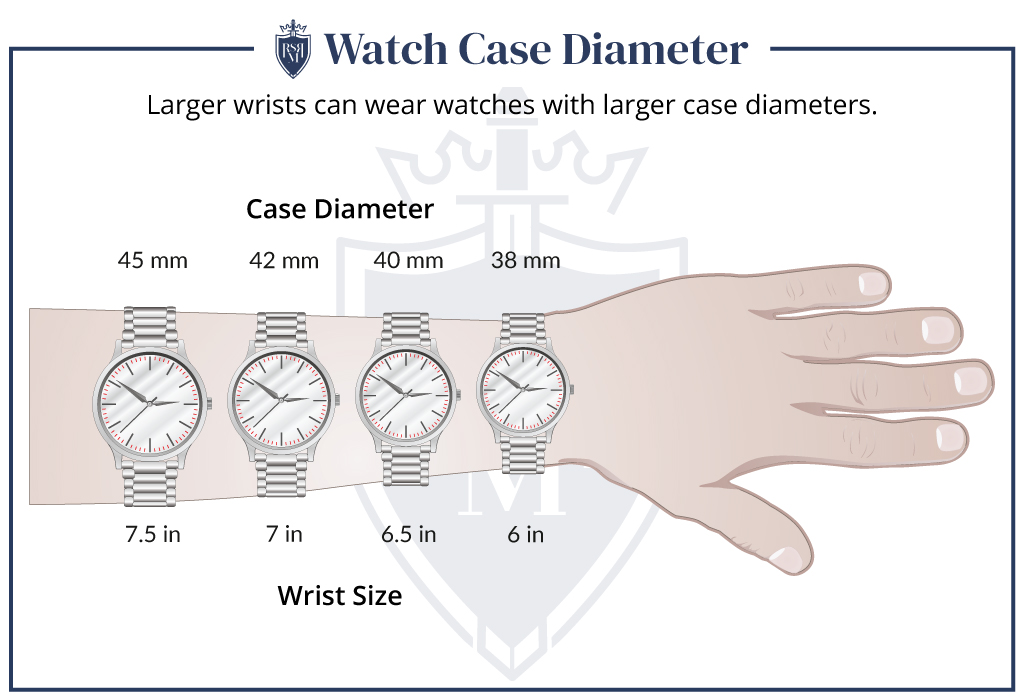
Case Diameter is the most obvious and noticeable element of proportion. Men’s watches usually range from 36mm to 46mm.
- Watch cases bigger than 46mm start to become too large and are usually reserved for rakish or flashy outfits.
- Watch cases smaller than 38mm used to be called women’s sizes. Not anymore. 34mm to 37mm watches are back for men, and on a slim wrist they look sharp.
So how do you know what size works for you?
Simple: measure your wrist.
How Do I Measure My Wrist For A Watch?

Wrap a tape measure around the area of the wrist you’d usually wear your watch on.
If you don’t have a tape measure, you can use a dollar bill. Modern US paper bills are 6.14 inches (156 mm) long — call it just over 6 inches. Wrap one around your wrist to get a rough circumference.
Then measure one more thing most guys skip: the width of the flat top of your wrist, from one side to the other. That number matters for the Lug Rule in Tip #7.
- Wrist circumference: 6 to 7 inches – you have a small to medium wrist. Look at 34mm to 40mm cases — the chart above gives your exact band.
- Wrist circumference: 7 inches and up – you have a medium to large wrist. Look at 40mm to 46mm cases, depending on where you fall in the chart.
Click below to watch the video on how to select the right watch size for your wrist:
Watch Size Tip #2 – Case Thickness (And The Cuff Rule)

Case thickness is oftentimes directly correlated to case diameter.
Back when mechanical watches were dominating the market, it was perceived that a thinner case was of higher quality.

This is no longer the case with electronic watches entering the market, as well as quartz designs.
A general rule is, as the diameter of the case increases or decreases, the thickness does as well.
Here’s what you’ll actually find: dress watches run about 6mm to 9mm thick. Everyday automatics usually land between 10mm and 12mm — Hamilton’s 38mm Khaki Field Murph is 11mm. Dive watches and chronographs run thicker; Omega’s 42mm Seamaster Diver 300M is 13.6mm.
The Cuff Rule: if you wear your watch with dress shirts and jackets, it has to slide under your shirt cuff. That gets hard once a case passes about 12mm. A thick diver catching on every cuff tells people you bought the wrong watch for your wardrobe.
Watch Size Tip #3 – Band Width

A well-proportioned watch usually has a band width of about half its case diameter. If you wear a 40mm watch, the width should be approximately 20mm in width.
Depending on your style preference you may want to wear a watch with a wider band width.
My preference is for smaller band widths, however, I do have smaller wrists.
If you have larger wrists you may lean towards wider bands.
If you are only shopping for cases and want to pick out a band later, you can determine what the width of the band will be based on the lug width.
Watch Size Tip #4 – Band Material
Leather bands are going to give your watch a slimmer look.
A metal watchband, even one the same size as a leather band, will always appear larger & heavier because of the nature of metal.
This is an important consideration if you have smaller wrists.
Metal bands will present the appearance of a larger watch, making it a primary choice for men with larger wrists.
Watch Size Tip #5 – Dial And Details

Last but not least, look at the size of the components on the watch.
This means notice the numbers, the hours, and second hands. The lug size, the pusher, and changer.
As these components grow in size and thickness it gives the illusion of a larger watch.
This can cause watches on men with smaller wrists to appear to be out of proportion, especially combined with any of the elements mentioned above.
The important thing to notice with components is how they play into the other elements of the watch.
If you have a 38mm to 40mm watch and the numbers are huge, it will look unbalanced.
On the flip side, if you have a 9mm thick watch with a 46mm case diameter and thin hour hands something might seem off as well.
Watch Size Tip #6 – Weight

Watch weight runs from featherweight quartz pieces on leather straps to nearly 200 grams for a steel diver on its bracelet — Omega’s 42mm Seamaster Diver 300M weighs about 192 grams.
Most of that weight comes from the case material and the bracelet, not the movement. Quartz movements are lighter than automatics, titanium is far lighter than steel, and the same watch on a leather strap can weigh about half what it does on a steel bracelet.
The weight of a watch is an important factor to consider when making your choice. Heavier watches tend to be more durable and have a higher quality feel, but they may also be uncomfortable on the wrist after extended periods of wear. Lighter watches are often more comfortable but may not have the same level of durability or quality as their heavier counterparts.
Ultimately, choosing the right watch weight comes down to personal preference and lifestyle needs. If you’re looking for something that will last longer and provide a higher quality experience, then opting for a heavier watch might be the best option.
Watch Size Tip #7 – Lug-to-Lug Distance (The Lug Rule)
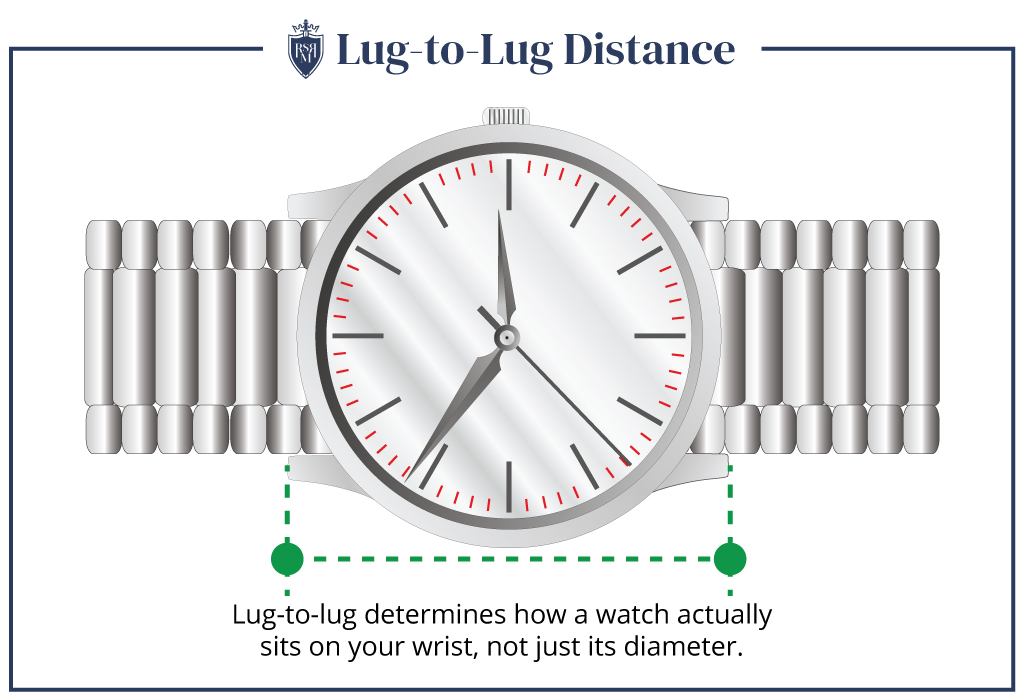
When it comes to choosing a watch, many enthusiasts focus solely on the case diameter, but one critical measurement often overlooked is the lug-to-lug distance.
This measurement can dramatically affect how a watch fits and appears on your wrist. For instance, the Omega Seamaster may have a 42mm case, but its 49.9mm lug-to-lug length means it wears smaller and fits more snugly than you might expect.
In contrast, the Nomos Ludwig, labeled as a 38mm watch, sports a 47.5mm lug-to-lug measurement, making it look larger on the wrist compared to the Hamilton Khaki Murph, which, despite also being 38mm in diameter, has a shorter 44.7mm lug-to-lug length.
Clearly, understanding lug-to-lug dimensions is key to finding a watch that not only meets your style but also offers the perfect fit.
The Lug Rule: lay the watch on your wrist and look straight down. The tips of the lugs should sit inside the flat top of your wrist. If they hang over the edges, the watch is too big for you — no matter what the diameter says.
(Thank you, Bill T. from SKOOL Watch Lover Community, for suggesting this addition!)
Selecting the right watch size is more than a style choice; it’s a matter of comfort and functionality. Begin by measuring your wrist accurately, considering both circumference and width.
The watch band plays a crucial role—choose one that complements your wrist size for a secure and comfortable fit.
Weight matters too; a well-balanced watch enhances wearability. Larger watches may appeal aesthetically but can overwhelm smaller wrists, affecting both style and comfort. Delve into lug-to-lug distance for a proportionate look.
Ultimately, the perfect watch size harmonizes with your wrist, creating a seamless fusion of style and comfort, ensuring that your timepiece becomes an extension of your personality.
Watch Size By Type: Dress, Everyday, Dive
The same wrist shouldn’t wear every watch at the same size. A dress watch is supposed to disappear under a cuff. A dive watch is a tool, and a little extra size reads right on it.

- Dress watch: the low end of your range, under about 9mm thick, on a leather strap. It should slide under a French cuff without a fight.
- Everyday watch (field, pilot, or a steel sports watch): the middle of your range. This is the one to size carefully, because you’ll wear it with everything.
- Dive watch or chronograph: the top of your range. The bezel and subdials already make it look bigger, so stay inside the Lug Rule.
Only own one watch? Size it as an everyday watch and keep it under the Cuff Rule. Then pick a strap to match — here’s how to choose the right watch strap.
Pick A Size For Your Build, Not Just Your Wrist
Your wrist isn’t the only thing people see. A 6’4″ guy with broad shoulders and a 7-inch wrist can wear a 42mm without it looking big. A slim 5’7″ guy with the same wrist usually looks better in a 38mm or 39mm. Proportion is about your whole frame.

- Big frame, big wrists: you can carry 42mm to 46mm. Here are watches for guys with large wrists at every budget.
- Slim frame: stay in the low-to-middle part of your band. A big watch makes a thin arm look thinner.
- Somewhere in between: trust the chart, then the Lug Rule.
When in doubt, try it on and have someone take a photo of you from six feet away. The mirror lies. The photo doesn’t.
The Quick Guide To Buying The Right Sized Watch For Your Wrist

Selecting the right watch involves more than just aesthetics; it’s a matter of finding the perfect fit for your wrist. Here’s the quick guide on how to choose the right watch size to ensure both style and comfort.
1. Case Diameter: Begin by considering the case diameter. Watches come in various sizes, and choosing the right diameter is crucial. For smaller wrists, opt for cases ranging from 34mm to 40mm, ensuring the watch doesn’t overpower your wrist. Larger wrists can handle cases above 42mm, providing a bold and impactful look.
2. Lug-to-Lug Distance: Pay attention to the lug-to-lug distance, the measurement from one end of the watch case to the other. This factor impacts how the watch sits on your wrist. Ensure the lugs don’t extend beyond your wrist edges, maintaining a balanced and proportional appearance.
3. Thickness: Consider the thickness of the watch. Thicker watches can be cumbersome on smaller wrists, while excessively slim ones may get lost on larger wrists. Strike a balance to achieve both style and comfort.
4. Strap Width: The width of the watch strap is equally vital. Wider straps complement larger wrists, providing a harmonious look, while narrower straps enhance the elegance on smaller wrists.
5. Personal Style: Finally, let your personal style guide your decision. Experiment with different sizes and styles to find the watch that resonates with your taste and complements your wrist size.
In essence, selecting the right watch size involves a blend of proportions, ensuring your timepiece not only looks good but also feels perfect on your wrist.
Now that you have the right watch, let’s talk rings. Click here to discover the secret world of signet rings.
FAQs: How To Buy The Right Watch Size For Your Wrist
Why is it important to buy the right watch size for my wrist?
The right watch size not only ensures comfort and ease of movement but also adds to your style. A watch that’s too large can overpower your outfit, while a too-small watch may not be easily readable or might look out of proportion.
What is the standard watch size for men?
Men’s watches typically range in case diameter from 38mm to 46mm. However, the ‘right’ size will ultimately depend on your personal preference and wrist size.
What is the difference between watch case size and band length?
The watch case size refers to the diameter of the watch face itself, whereas the band length is the total length of the watch’s strap or bracelet.
Can I wear a large watch if I have a small wrist?
While it is ultimately a matter of personal preference, a large watch on a small wrist might look out of proportion. It might also be uncomfortable and can interfere with movement.
What is the ‘lug-to-lug’ measurement and why is it important?
Lug-to-lug measurement is the distance from the top of the watch to the bottom, including the lugs where the strap is attached. It helps you understand how the watch will sit on your wrist, which is crucial for comfort and appearance.
What happens if my watch is too tight?
A watch that is too tight can restrict blood circulation and may cause discomfort. It can also cause the watch to wear out faster due to excessive strain on the band.
Does the material of the watch band affect sizing?
Some materials like leather or fabric might have more flexibility and give than metal bands, which could affect how the watch fits on your wrist.
How can I tell if my watch is the right size for my wrist?
A watch is typically the right size if the case and dial rest comfortably on your wrist without digging in or sliding around too much. The lugs shouldn’t extend over your wrist.
Can I wear my watch on either wrist?
Yes, you can wear your watch on either wrist. Traditionally, watches are worn on the left wrist but this isn’t a hard and fast rule.
Do I need a different watch size for formal and casual settings?
Not necessarily. While larger watches might look more casual and smaller watches more formal, the most important thing is that the watch fits well and suits your style.
How does the size of the watch affect its cost?
Generally, the size of the watch doesn’t directly affect its cost. The price usually depends on factors like the brand, materials used, craftsmanship, and the complexity of the watch’s movement.