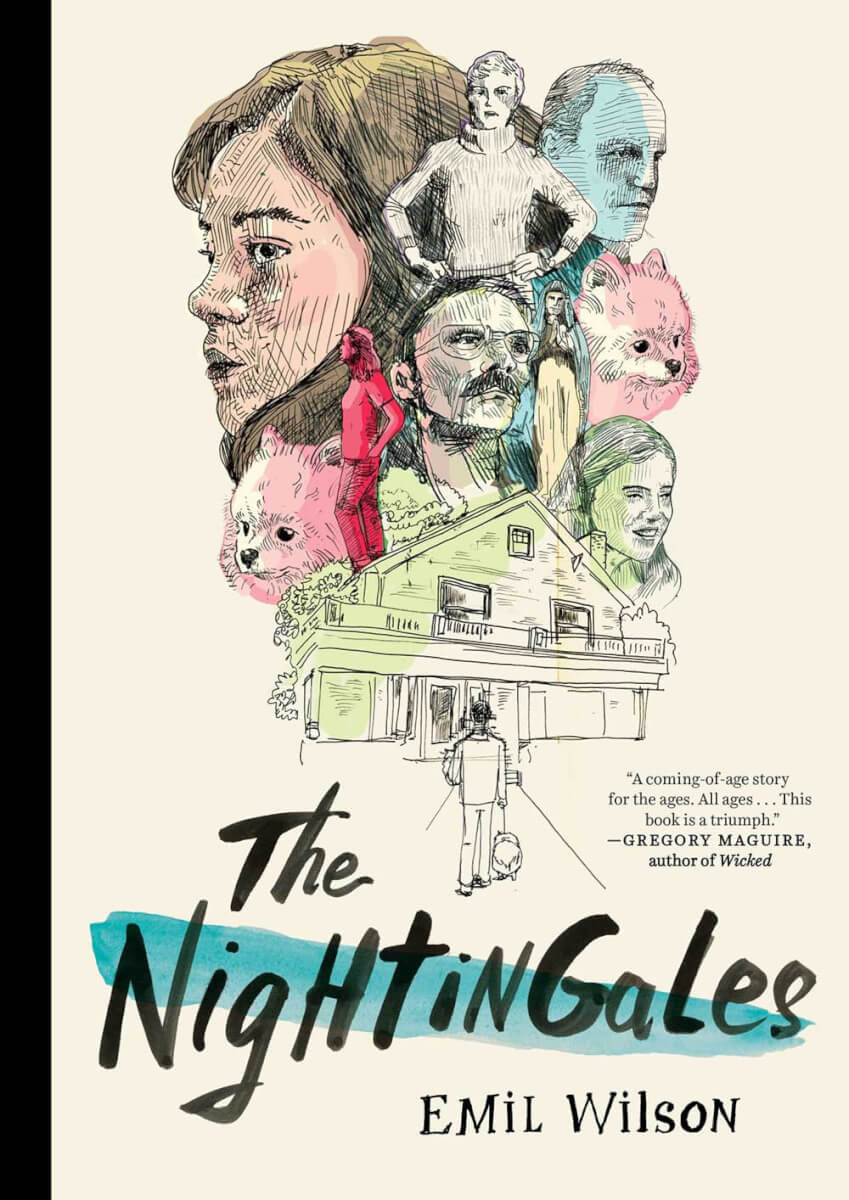
Emil Wilson’s first graphic novel, The Nightingales, is based on the true story of his father’s invitation to a co-worker, dying of AIDS in 1985, to move in to the family home. The fictionalized version of the story, presented as if from the pages of a sketchbook, follows Wilson’s sister, Lou, as she builds a friendship with that co-worker, Jim, and his two Pomeranians, Henny and Penny. It’s the kind of graphic novel that must be read quickly, as it is both propulsive and painful.
The central narrative of Lou and Jim’s bond is boxed in by the iced-up family dynamics at home. Emil, gay and out, has moved away after too many screaming matches with his controlling, disapproving mother, Annemarie. Lou and Emil’s dad, Donald, picks his moments to go against his wife’s wishes. And Lou, soon to graduate from high school, is watching it all and finding sanctuary with her new housemates, Jim and the dogs.
Wilson’s artistic style is bold and soft, with bleeding color washes as tender, messy and raw as the characters’ unresolvable feelings. Elements often overlap, as Lou bears witness and recalls dialogue in scrapbook-style scripts. When Annemarie interacts with Jim, the overlapping images become anxious “points of contact” through which the “gay plague” might threaten the home. Scenes in which Annemarie converses with the Virgin Mary, and when Lou “watches” a talk show hosted by Henny and Penny, add to the sense that the characters are living in private internal vistas, walled off from one another.
Comparisons to Fun Home are inevitable, not only because Alison Bechdel’s time-bending “tragicomic” graphic memoir was such a pioneering queer coming-of-age book, and not only because both books have the potential to leave readers eviscerated with grief, but also because of how a parent eclipses the narrative. In Fun Home, Bechdel’s father and his untimely death are the clear updrafts of the storm; in The Nightingales, it is slowly made clear that Annemarie is the anvil looming over their lives, from whom all must seek shelter.
The story is really about the nature of care. There’s the tenderness that Lou brings to the world; the harm caused by Annemarie’s form of care, born out of fear and look-out-for-your-own Reagan-era conservatism; and the difficulty of understanding the difference between the two. And as much as each character is archetypal, they’ve been crafted thoughtfully to avoid cliche. Wilson ends his monumental first book with a sense of hope, but one that’s constructed by brute perseverance and exists in spite of, not because of, the state of the world.