“I desperately, desperately, more than anything in the world wanted to be a guitar player,” M.L. Rio confesses, “but I couldn’t stop breaking my fingers long enough to actually get good at it.”
Those breaks came from being a “rough-and-tumble kid” who played contact sports and grew up with an older brother. So, instead of becoming a rock ’n’ roll hero, she ended up studying Shakespeare in England, earning a Ph.D. in English and becoming a writer. Her 2017 debut, the now-canonical dark academia thriller If We Were Villains, involves a mystery within a troupe of Shakespearean actors, and her 2024 novella, Graveyard Shift, concerns a group of night workers whose paths cross in a cemetery where a suspicious gravedigger lurks.
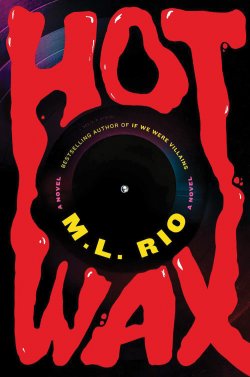
Now, Rio returns to her jamming days with Hot Wax, a wild saga that she pitched to her agent as This Is Spinal Tap meets Thelma & Louise. It contains two parallel narratives: The “A side,” as it is called in the book, chronicles 10-year-old Suzanne as she accompanies her father’s up-and-coming band, Gil and the Kills, on a blazing cross-country concert tour in 1989. The “B side” tracks 41-year-old Suzanne as she runs away from her marriage while trying to come to terms with the disastrous repercussions of that childhood journey, hoping to finally find herself in the process.
“I wanted to prove that a book about something ‘low brow’ could still have a lot of the elements of high art.”
“I wanted to prove that a book about something ‘low brow’ could still have a lot of the elements of high art and go really deep on character development,” Rio says, speaking by phone from her home in Philadelphia. “But I also wanted to write a book that was fun and would keep the pages turning. I think we’ve kind of gotten to a place with literary fiction, especially by women, where there’s this expectation that it’s very quiet and very subdued and very self-serious. And this book is not that at all. This book is big and loud and maximalist and very off-trend.”
Rio has used her training as a performance studies scholar and work experience as both an actor and as a music writer to inform her writing—and reading. She says, “I’ve lived a lot of my life backstage. And there are many, many novels about the theater, and many novels about music, but very few of them feel like they’re really getting it right.”
The itinerant life of a performer is also familiar to Rio, who recently moved to Philadelphia after living out of her car for a few years while working on Hot Wax. “Intentionally, and not out of hardship,” she says. “I am sort of getting used to having a permanent address, and it’s really more of a crash pad than anything else because I still travel close to 200 days a year.” This summer she’ll attend book festivals and writing retreats, do some teaching and campus visits, and go on research trips for her next book. Fall brings a book tour, during which she’ll drive 15,000 miles or more in about six weeks, just like how the adult Suzanne racks up the miles on her journey.
The “B side” narrative kicks into action when Suzanne receives an inheritance from her long-estranged father, which includes residuals from his music as well as “Blondie,” the ’68 Ranchero GT with a 428 Cobra Jet engine that young Suzanne and her father drove during that fateful concert tour in 1989. It is, the novel notes, “a literal truckload of shit she’d already tried to leave behind.”
Like Suzanne, Rio also developed a love of music through her father. “He was not a rock star himself. Sadly, for me. Or, perhaps that’s fortunate,” she says with a laugh, “looking at what unfolds in this book.” Instead, Rio’s father grew up in Los Angeles “in the heyday of the rock ’n’ roll scene.”
“In high school and college,” she says, “he [was a bouncer at] a lot of concerts and a lot of big music festivals, like Cal Jam at Ontario Motor Speedway. So, I grew up on all of my dad’s stories about these crazy shows he went to. My dad’s first concert was Zeppelin at the Forum in ’72, when he was 14. I will be sick with envy about that until the day I die, even though I wasn’t even alive.”
When she was 9, Rio’s father “dropped a pile of CDs” on her bed, instructing her to “educate herself.” “It was all over from there,” she recalls. By the time she was 14, she was sneaking into concerts with friends. During one memorable show, she was in the mezzanine when the railing broke. “We all just fell into general admission,” she says. “It wasn’t a long fall, but the problem was everybody in general admission just assumed that a fight was starting. So, it turned into a brawl.” That incident is one of the many personal experiences that became fodder for—shall we say—lively scenes in Hot Wax.
Vinyl records, she adds, served as a particular inspiration. “I’m a very avid record collector. It’s an extremely inconvenient hobby for someone who moves as much as I do, because they’re heavy, they’re fragile and they’re heat sensitive. I had an absolutely nightmarish experience moving all my stuff into the storage unit when I was on crutches and in an absolute panic that all my records were going to melt in the back of a moving van.”
Rio first conceived of Hot Wax in 2016, but soon set it aside, which is a story in itself: When If We Were Villains was published in 2017, it “pretty much flopped,” she says—so she never got far with her second novel. However, during the pandemic, Villains’ popularity began to surge as more people were reading, and the book became a TikTok sensation. “I am not on TikTok and have never been, but at a certain point my friends started telling me ‘Your book is exploding.’ ” She continues, “The really cool thing about it is it’s readers who brought that book back from the dust bin of literary history and made it a sleeper hit. It was this totally organic grassroots thing. That’s the best side of internet culture.”
“I wanted the narrative to mimic the feeling of a road trip.”
Alerted to her TikTok fandom and eager to ride the popularity wave, Rio got busy writing Graveyard Shift and revisited her Hot Wax manuscript. When she had first conceived her rock ’n’ roll saga, she had bought big wall maps to chart where several real bands toured during that era, ending up with “messy maps that had all of these kind of crazy Mindhunter bits of highlighter and push pins and strings.” Calling herself “a method writer,” she says she also consulted a Rand McNally atlas from the same year that Gil’s band would have been touring.
“I wanted to have the two plot lines kind of hurtling toward each other at the same time that they move westward across the country,” Rio says. “I wanted the narrative to mimic the feeling of a road trip.” All the planning paid off. Her fast-paced novel tackles its two parallel timelines seamlessly until they converge geographically and thematically.
Rio ended up making major plot changes to Hot Wax during her own cross-country journey. For instance, including ghost towns, a major focus of the end of the narrative, didn’t occur to her until she stumbled upon them in the Southwest. She also changed the name of her main character and made her younger during the tour. Suzanne, she says, “became the perfect observer” for all of the backstage and band-on-the-move chaos, not to mention the intoxication of fame and adulation. “Seeing it through the lens of a child, I think, brings you that much closer, because they don’t have the cynical filters that we have by the time we’re adults.”
The adult Suzanne also ends up on a road trip, but not in a muscle car. She experiences “van life,” traveling and living with a young couple, Simon and Phoebe, in an RV they call the Lifeboat. “I loved learning how people are making alternative lifestyles work for them, and it was fascinating to discover the ways people find to live in such tiny environments.” Exposure to Simon and Phoebe’s freewheeling life helps Suzanne realize “that nuclear families are not the answer for everyone, and that sometimes insisting on that model of life does a lot more harm than good.”
Additionally, Rio read “more music biographies than I can even count” and watched “thousands and thousands of hours of concert footage” from the era. Such research came naturally, since she tends to “have music on in one way or another, like 16 hours a day. Just because my brain can’t function without it.” (Her playlist for this project contains about 200 hours of music.) Rio also listened to bootleg records that gave her both a sense of what some concerts sounded like live and “a sense in real time how people are reacting to what’s happening onstage and how the performers are feeding on that. That interaction between performer and audience is exactly the spice of live music,” she says. That sort of electricity is exactly what fuels her novel—Gil and the Kills aim to put on killer live shows.
“They’re big and loud and campy and theatrical,” Rio says, “but in a New York Dolls kind of way and not a KISS kind of way.” Gil says at one point, very emphatically, “We’re not Mötley fucking Crue.”
Writing song lyrics for her imaginary band proved to be challenging—Rio calls herself “a terrible poet.” “It was an interesting kind of ventriloquism because I’m not just writing songs as me, I’m writing songs as Gil,” she adds. “Unlike everything else that I write, I had to just sit down and let them occur to me in the moment. Lyric writing is much, much better off the cuff. Once I had done more of it, it did start to come a little more naturally. And there were a couple that I ended up really liking and kind of being like, man, I wish a band could actually record this.”
In addition to writing music, Rio had to flesh out some complicated characters, especially Gil and Skelly. “I have always been drawn to fiction that is filled with thorny, difficult people just because I think that’s truer to life than having really clear-cut good guys and bad guys,” she says. “And I think what really happens at the heart of this book is everyone who should be protecting this child fails her in a different way.”
A climactic scene near the end blows up the relationships between Gil, Skelly and Suzanne. And while the scene is filled with vivid, precise writing, readers are left to fill in some details and draw their own conclusions. “I really like ambiguity,” Rio explains, “because I think it requires a more active reading experience. It asks the reader to do some interpretation and make some educated guesses about what doesn’t happen on the page. Some readers find that really frustrating, but I don’t like tying things up with a neat little bow.”
“I’m very grateful for readers who have been willing to go with me on all these very different tangents, because I do like playing with all kinds of different genres,” Rio says. As for her next project: “I’m excited to strike out in a new direction.”
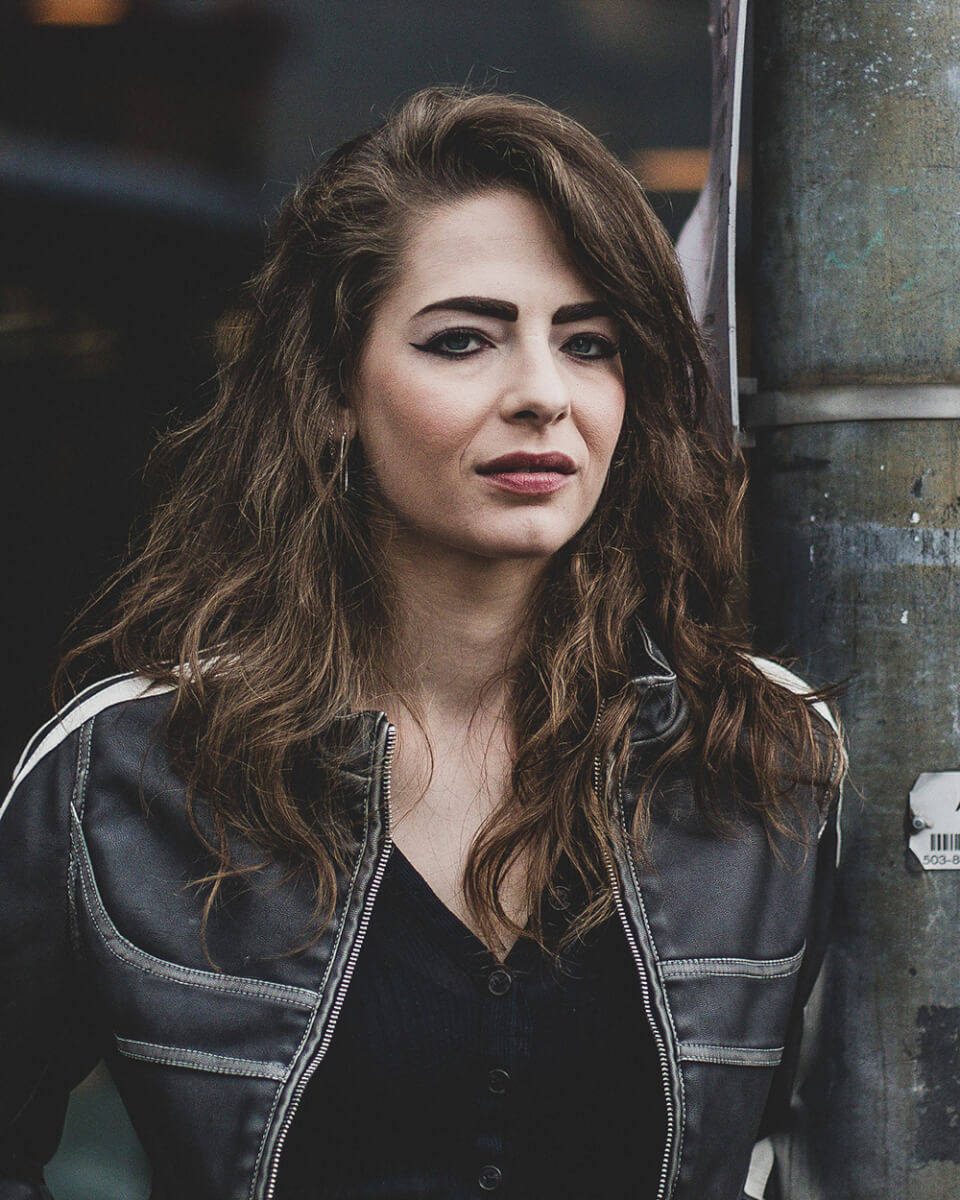
Author photo of M.L. Rio by Helena Santos.