
You step outside and the cold hits your face like a slap. So you pile it on—thermal, hoodie, sweater, puffer—and twenty minutes later you’re sweating on the train, looking like a stuffed duffel bag, and still somehow cold at the wrists and ankles.
I’ve lived through Wisconsin winters where I had to warm the oil in my truck before it would start. My wife is Ukrainian, and a Kyiv January means snow, ice, and wind coming off the Dnipro. Both places taught me the same lesson about winter layering for men: staying warm has nothing to do with how MUCH you wear. It comes down to what each piece does and the order you put it on.
In this guide I’ll show you the three-layer system—base layer, mid-layer, outer shell—the winter fabrics that work (and the one that works against you), how to keep your silhouette sharp under all that clothing, and six outfits you can copy from the first frost to the March thaw. There’s also a temperature chart so you know what to wear at 40°F, 15°F, and 10 below.
Let’s get into it.
1. Why Most Men Get Winter Layering Wrong
Most guys make one of two mistakes.
Mistake #1: One giant coat over a T-shirt. The coat does all the work, so outside you’re fine. Then you walk into a 70-degree office, take the coat off, and you’re standing there in a thin cotton tee in January. You also have nowhere to go when the wind picks up—the coat is all you’ve got.
Mistake #2: Piling on thick layers that all do the same job. A hoodie under a chunky sweater under a puffer is three insulating layers fighting for the same space. They crush each other, which kills the trapped air that actually keeps you warm, and they turn your frame into a rectangle.
Here’s the deal: warmth comes from still air trapped close to your body, kept dry from the inside and protected from wind on the outside. Every layer you wear should have one of those three jobs. If it doesn’t, leave it at home.
I wrote about the basics of cold weather dressing for men years ago. This guide goes deeper—a full system you can adjust to any temperature and any dress code.
2. The 3-Layer System: Base Layer, Mid-Layer, Outer Shell
Mountaineers and soldiers have dressed this way for decades because it works. A Marine on a winter field exercise doesn’t wear one massive parka. He wears layers he can add or strip as he moves, sweats, and stops. You’re not climbing a mountain on your commute, but the physics doesn’t care.
Layer #1 – The Base Layer (Manage Moisture)

The base layer sits against your skin. Its job is to move sweat away from your body so you stay dry, because wet skin loses heat fast.
What to wear: a merino wool T-shirt or long-sleeve crew, a thin synthetic thermal top, and when it’s truly cold, matching thermal bottoms under your trousers.
How it should fit: close to the body, like a second skin—snug, never tight enough to show seams through your shirt. A loose base layer can’t wick, and it bunches at the waist.
Pick your weight by the weather. Base layers come in lightweight, midweight, and heavyweight. Lightweight is plenty for an office day around freezing. Save heavyweight for standing still in serious cold—a football game, a ski lift, waiting on a train platform at 5°F. If you want the full breakdown, here are my 5 rules for picking the right base layer.
Layer #2 – The Mid-Layer (Trap Heat)
The mid-layer is your insulation, and it’s the layer people actually see once your coat comes off. This is where most of your style lives in winter.
What to wear: your shirt (Oxford cloth button-down, flannel, chambray, a wool shirt) plus one insulating piece on top—a lambswool or merino sweater, a shawl-collar cardigan, a quilted vest, an overshirt, or a sport coat in tweed or flannel. In real cold, a fleece or thin down vest can hide under a sport coat or overcoat.
Why it works: lofty, textured fabrics hold pockets of still air. That’s why a thick lambswool crewneck feels warmer than a smooth cotton sweater of the same weight.
Rule of thumb: one insulating layer for most days, two when the temperature drops into the teens or you’ll be outside for hours. Two thin mid-layers beat one huge one—you can take one off.

Layer #3 – The Outer Shell (Block Wind and Wet)
Your outer layer keeps the wind from blowing away the warm air you just trapped, and keeps snow and sleet from soaking in. In a stiff wind, an outer layer that blocks wind matters more than one more sweater.
What to wear: a dense wool overcoat or topcoat, a peacoat, a waxed cotton jacket, a parka, or a down or synthetic-fill puffer. Which one depends on your climate and your day. If you’re torn between the classics, I break down the overcoat vs. peacoat vs. parka question here.
Length matters. A coat that covers your hips keeps your core and the top of your thighs warm. A cropped jacket over a thin shirt leaves a cold band right at the waist—exactly where heat escapes when you bend or sit.
3. Winter Fabrics: What Keeps You Warm and What Doesn’t

Fabric decides whether a layer works. A perfect three-layer system in the wrong fabrics will still leave you cold.
Merino wool – The best all-around base layer. Fine fibers, so it doesn’t itch like your grandfather’s army sweater. It still insulates when it gets damp, and it resists odor, so you can wear a merino tee a couple of days on a trip without it turning on you. Fine-gauge merino sweaters are also the slimmest mid-layer you can wear under a sport coat.
Lambswool and Shetland – Thicker, loftier, and a bit rougher than merino. These are your workhorse winter sweaters. They have texture, which reads as warm and rugged next to smooth trousers.
Cashmere – Very warm for its weight and very soft. Great for scarves and fine sweaters. It’s expensive and less durable at the elbows, so it’s a luxury, not a necessity.
Wool flannel and tweed – The fabrics for winter tailoring. Flannel trousers and a tweed sport coat block a surprising amount of wind and look right in January in a way that a summer-weight worsted suit never will.
Down – The warmest insulation for its weight, which is why serious parkas use it. The weakness: when down gets soaked, it clumps and loses its loft—and its warmth. Fine for dry cold; keep it under a shell in wet snow.
Synthetic insulation and fleece – Not as warm as down for the weight, but it keeps insulating when damp and dries fast. A smart choice for wet climates and for the guy who’s shoveling or hiking and going to sweat.
Waxed cotton – Not insulation, but a great outer shell for wet, windy, above-freezing days. It sheds rain and sleet and gets better-looking with age.
The Fabric That Works Against You: Cotton Next to Your Skin
Cotton soaks up moisture and holds it. Once it’s damp, it stops insulating and starts pulling heat out of your body. Outdoorsmen have a blunt saying for it: “cotton kills.”
That doesn’t mean you throw out your Oxford shirts. A cotton shirt as part of your mid-layer is fine on a normal workday. The problem is a cotton tee as your base layer when you’re going to sweat—walking fast to the train, shoveling the driveway, hauling luggage through an airport—and then stand still in the cold. Swap that one piece for merino and you’ll feel the difference the first morning.
Same goes for socks. Wool socks are non-negotiable in real winter. Cotton socks plus a cold sidewalk means damp, frozen feet by lunch.
4. The Peel-Down Rule: Every Layer Has to Look Finished

This is the part most winter style guides skip, and it’s the one that separates the guy who looks put together from the guy who looks like he lost a fight with his closet.
In winter you don’t wear one outfit. You wear three or four, depending on where you are. Outside at 10°F you’ve got everything on. On the train you open the coat. At the office the coat comes off. By 2 p.m. near a radiator, the sweater might come off too.
The Peel-Down Rule: every time you take a layer off, what’s left should look like a finished outfit.
Here’s how to check it. Before you leave the house, mentally peel the outfit layer by layer:
- Coat off – Do the sport coat, sweater, and trousers work together on their own? Do the colors and textures make sense without the coat tying them together?
- Sweater off – Is the shirt underneath something you’d wear on its own—pressed, fitted, collar that holds its shape? Or is it a wrinkled shirt you figured nobody would see?
- Base layer – Is it invisible? A thermal cuff sticking out past your shirt sleeve, or a gray crew neckline showing under an open collar, breaks the look. Wear a V-neck or a crew that sits below an open collar, and keep base-layer sleeves shorter than your shirt sleeves.

The guys who fail this test are usually the ones wearing a great coat over a sloppy outfit. Most of the time, people see you indoors. Build the outfit from the inside out, and treat the coat as the frame, not the picture.
The same thinking runs through my 10 rules for layering men’s clothes—and it’s the reason I’d rather see a man in a sharp sweater-and-shirt combo with a plain coat than the reverse.
5. How to Layer for Winter Without Looking Bulky

Warm is easy. Warm AND sharp takes a little planning. These are the rules I follow.
Go thin to thick. Thinnest fabric against your skin, thickest on the outside. A heavy cable-knit under a slim sport coat will never sit right. Put the bulk where there’s room for it—under an overcoat, not under a blazer.
Go tight to loose. Each layer should be a touch roomier than the one beneath it. Base layer snug, shirt trim, sweater fitted but not clinging, coat with enough room to close over all of it without pulling at the buttons.
Buy your winter coat for the layers you’ll wear under it. Try coats on wearing your thickest sweater, or a sport coat if that’s how you’ll wear it. Most men need to go up a size from their sport coat. Then take it to your tailor. A good tailor can shorten the sleeves so about a half inch of shirt cuff shows past the jacket underneath, and the coat sleeve covers the jacket sleeve. That’s the detail that makes a heavy coat look like it was made for you.
Use texture instead of thickness. Tweed, flannel, corduroy, a ribbed knit—texture makes an outfit look warm and interesting without adding inches. A flat charcoal sweater with a flat gray shirt and flat gray trousers reads as one gray blob. Swap one piece for a rougher fabric and the outfit has depth.
Keep the colors simple. When you’re stacking four layers, they all have to get along. Build around two or three colors—navy, charcoal, camel, olive, brown, cream—and let one accessory carry the color. I go deeper on this in cold-weather color combos that look sharp.
Adjusting for Your Build
If you’re slim or tall: winter is your season. Layers add the bulk your frame is missing. Chunky knits, shawl collars, double-breasted peacoats, and heavier tweeds all help. More ideas in my guide on how to dress as a skinny guy.
If you’re heavier or broad through the middle: keep your mid-layers fine-gauge and dark, skip the chunky knits and puffy vests, and choose a single-breasted overcoat that falls to the knee. A long, unbroken vertical line from collar to hem makes you look taller and leaner. A puffer that ends at the waist does the opposite.
If you’re short: watch coat length. A coat that hits just above the knee or at mid-thigh keeps your legs looking longer than a full-length overcoat. Keep your colors close in tone from top to bottom.
6. How to Dress for Sub-Zero Temperatures
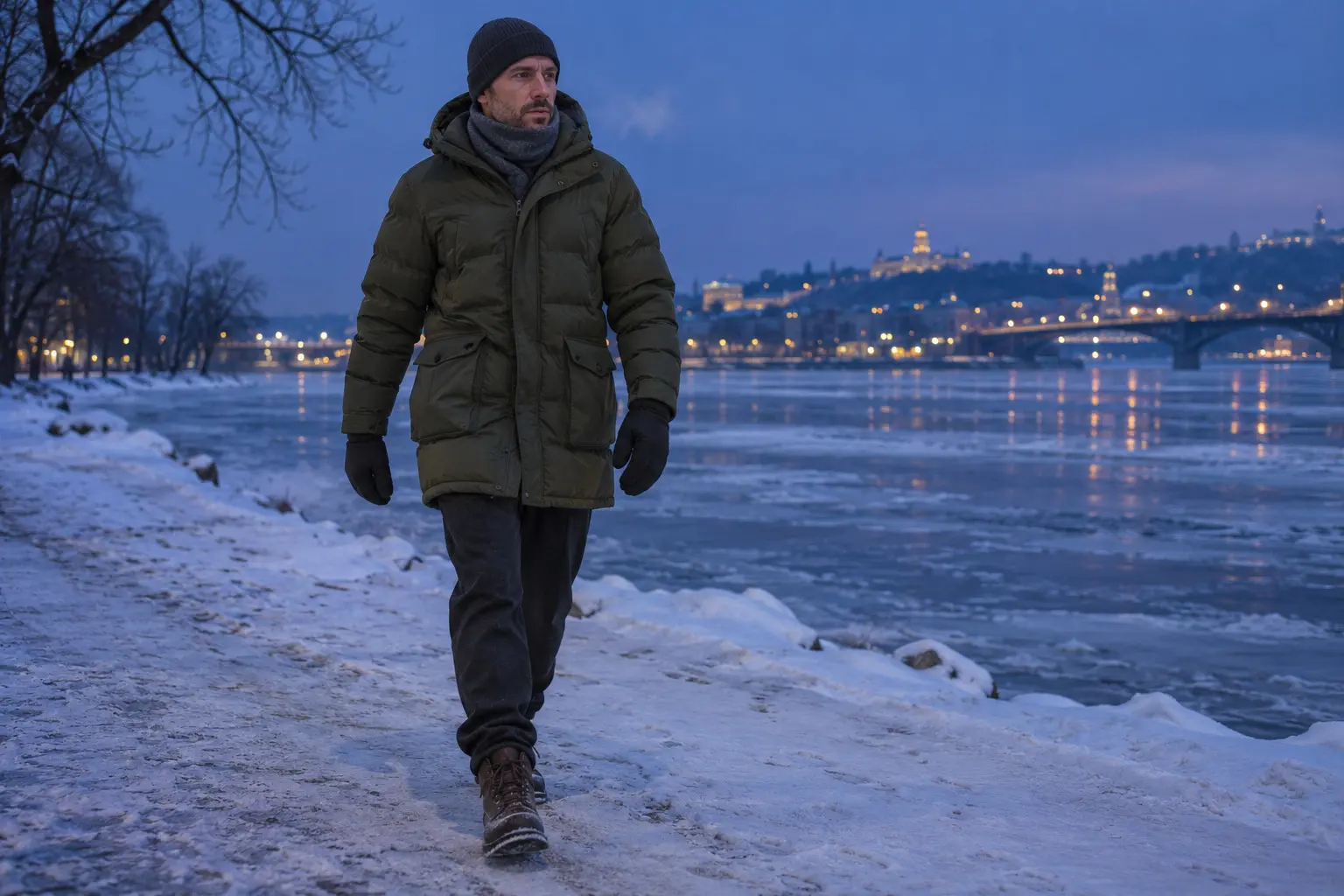
Below 0°F (?18°C) the rules change. You still want to look sharp, but now the cold can do real damage to exposed skin. Function comes first; style rides along.
Dress for the wind chill, not the thermometer. Wind strips heat off exposed skin fast. According to the National Weather Service wind chill chart, once the wind chill reaches about ?20°F, exposed skin can get frostbite in around 30 minutes. Near ?35°F, that drops to about 10 minutes. Check the “feels like” number before you get dressed.
Layer your legs, too. Men will wear three layers on top and a single pair of jeans on the bottom. Below zero, thermal bottoms under wool trousers or heavy denim are mandatory. If you’re a jeans guy, here’s how to wear jeans in cold weather without freezing.
Your outer shell has to block wind and cover your hips. This is where a down or synthetic parka with a hood earns its place. If your work demands a tailored look, wear a heavy wool overcoat with a thin packable down vest underneath—nobody sees it, and it adds a lot of warmth.
Cover your extremities. Your hands, feet, ears, and face get cold first, because your body pulls blood back to your core to protect it.
- Head: a wool beanie that covers your ears, or a trapper or ushanka-style hat when it’s brutal.
- Neck and face: a wool or cashmere scarf you can pull up over your nose. Tuck it inside your coat collar to seal the gap. Here are 10 masculine scarf knots that stay put.
- Hands: lined leather gloves down to about 15°F. Below that, mittens—or a thin liner glove inside an insulated glove.
- Feet: insulated, waterproof boots with rubber soles and room for a thick wool sock. A boot that’s too tight cuts circulation and your feet get colder. Here’s how to buy cold weather boots that last—and how to protect them from salt and snow.
Don’t overheat before you go out. If you get fully dressed and then spend ten minutes looking for your keys, you’ll start sweating—and you’ll step outside damp. Put the coat, hat, and gloves on last, at the door.
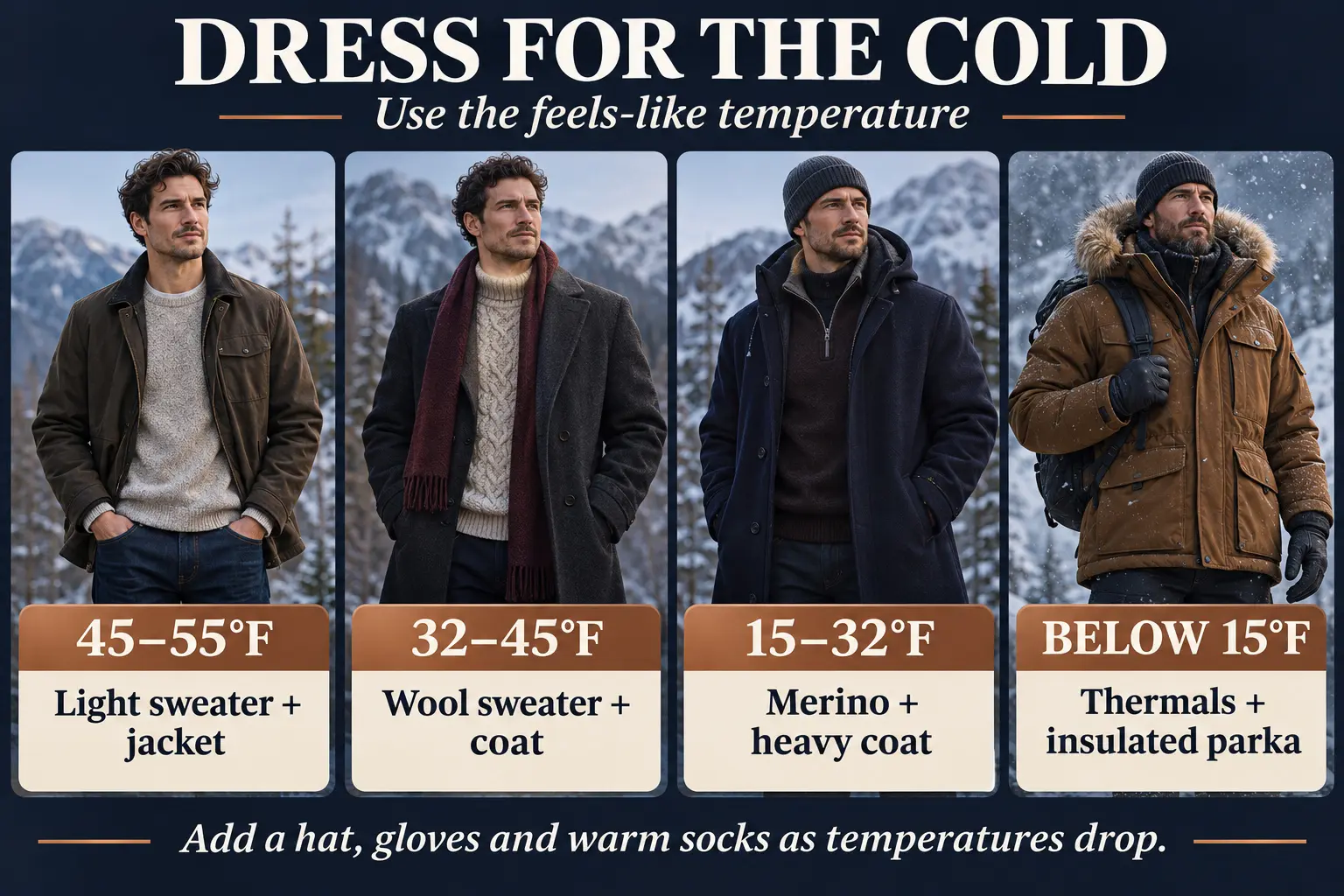
7. Winter Layering Chart: What to Wear at Every Temperature
Bookmark this one. Find the temperature—use the “feels like” number—and build from the base layer out.
The RMRS Winter Layering Chart
What to wear at every temperature, from base layer to boots
Use the “feels like” wind chill, not the air temperature. Per the National Weather Service, exposed skin can get frostbite in about 30 minutes at a wind chill near ?20°F.
Notice the pattern: as it gets colder, you add warmth under the coat first. Upgrade the base layer and add a vest before you buy a bigger coat.
8. 6 Winter Layered Outfits for Men (Early, Deep, and Late Winter)
Winter isn’t one season. Early winter is crisp and dry, deep winter is brutal, and late winter is wet, gray, and slushy. Here are two outfits for each—copy them as-is or swap in what you own.
Early Winter (30s–40s°F)

Outfit #1 – The Office: merino V-neck tee, light blue Oxford cloth button-down, charcoal lambswool crewneck, brown tweed sport coat, navy wool flannel trousers, camel overcoat, dark brown suede Chelsea boots with rubber soles. Peel-down check: coat off, you’re in a tweed jacket outfit. Jacket off, sweater and OCBD. Every stage works.
Outfit #2 – The Weekend: cream waffle-knit henley, red-and-green tartan flannel shirt worn open, olive waxed cotton jacket, dark indigo jeans, brown leather work boots, navy wool beanie. The henley carries the outfit when the flannel comes off.
Deep Winter (Below 15°F)

Outfit #3 – The Sub-Zero Commute: midweight merino top and bottoms, white Oxford shirt, navy shawl-collar cardigan, gray flannel trousers, thin packable down vest, charcoal wool overcoat cut to the knee, cashmere scarf, lined black leather gloves, insulated black leather boots. At the office, the vest goes in your bag, the cardigan stays on, and you look like the most comfortable man in the building. For more office ideas, see my guide to winter business casual for men.
Outfit #4 – Date Night: lightweight merino base layer, black merino turtleneck, charcoal flannel trousers, navy double-breasted peacoat, gray cashmere scarf, dark brown leather gloves, black Chelsea boots. The turtleneck does double duty—it seals your neck from the cold outside and looks sharp at the table once the coat is off.
Outfit #5 – The Deep-Cold Weekend: heavyweight merino top and bottoms, cream Aran (fisherman) sweater, flannel-lined chinos or dark heavyweight jeans over thermals, navy or olive down parka with a hood, charcoal wool beanie, insulated mittens, waterproof insulated boots. This is the outfit for sledding with the kids, walking the dog at dawn, or a day at a winter market.
Late Winter Thaw (35–45°F and Wet)

Outfit #6 – The Slush Season: merino crew tee, denim or chambray shirt, olive quilted vest, navy waxed cotton jacket or a water-resistant mac, dark chinos, rubber-soled leather boots treated with a protector, wool socks. Down hates wet weather, so this is where synthetic fill and waxed cotton take over. More on this in how to dress sharp in cold rain.
Want to build all six from as few pieces as possible? Start with my 10-piece winter capsule wardrobe.
9. Winter Layering FAQ
Is cotton bad to wear in winter?
Cotton is fine as a shirt in your mid-layer on a normal day. It’s a bad choice for your base layer if you’re going to sweat, because it holds moisture and loses its warmth once it’s damp. Wear merino or a synthetic against your skin and save cotton for the shirt on top.
How many layers should I wear when it’s below 0°F?
At minimum three on your torso—a base layer, an insulating mid-layer (sometimes two), and a windproof outer shell—plus thermal bottoms on your legs. The number matters less than the job each layer does. Two layers that both insulate and none that block wind will still leave you cold.
Is merino wool or synthetic better for a base layer?
For everyday wear and travel, merino. It stays warm when damp, resists odor, and looks like a normal tee. Synthetic dries faster, costs less, and holds up better to hard use, so it’s the better pick for shoveling, skiing, or anything where you’ll sweat hard.
Do you really lose most of your body heat through your head?
No—that’s a myth. Researchers writing in the BMJ found the head accounts for roughly 7–10% of heat loss, about in line with its share of your body’s surface. But when everything else is covered, your bare head and face are what’s left exposed. Wear the hat.
Start With One Upgrade
You don’t need a new winter wardrobe this week. Start with the piece that gives you the biggest return: a merino base layer. It’s cheap compared to a coat, nobody sees it, and it’ll change how warm you feel in clothes you already own.
Then run the Peel-Down Rule on tomorrow’s outfit. If any stage of it doesn’t look finished, that’s your next upgrade.
For a quick visual version of this system, check out my cold weather layering infographic and these cold climate dressing tips.
Stay warm. Stay sharp.