
Ever see a man pull off a vintage look — pleated wool trousers, a tweed jacket, a knit tie — and think, “I want that”? Then you try it yourself and end up looking like an extra from a period movie.
That’s the trap with vintage style. Done right, it reads as classic and confident. Done wrong, it reads as a costume. The difference comes down to two things: how many old pieces you wear at once, and whether they fit the body you have today.
For most guys, the spark comes from movies — either films made decades ago or period pieces shot today. Some are enamored with the “old money” elegance in The Talented Mr. Ripley (1999), while others find themselves more drawn to Robert De Niro’s flashy ensembles in Martin Scorsese’s mob epic, Casino (1995). Perhaps you’re into the exemplary displays of Ivy Style portrayed in Dead Poets Society (1989), or the 70s take on the look in The Holdovers (2023).

The real world holds plenty of style stimulation, as well. Maybe your favorite style influencer recently put you on to an especially cool retro look. Or you passed someone on the street with head-turning taste.
Whatever your source of inspiration, and whatever particular aesthetic that’s caught your eye, there’s one truth that remains consistent across practically all of these experiences and others like it: vintage style can be pretty darn cool, and a ton of fun!

But liking the look and knowing how to wear it are two different things. So below you’ll find the one rule that keeps a vintage look from turning into a costume, plus 12 tips on where to shop, what to wear, and how to make old clothes fit a modern man. Let’s get into it.
The Golden Rule Of A Vintage Look: One Era Piece At A Time

Here’s the mistake I see constantly. A guy gets excited, buys a fedora, a three-piece pinstripe suit, a pocket watch, and two-tone spectator shoes — and wears them all on the same Saturday. Every piece is fine on its own. Together, he looks like he’s headed to a theme party.
The fix is simple. Build every outfit around one piece that clearly belongs to a specific decade, and keep everything else timeless. Timeless means the stuff that never went away: navy, grey, and brown; oxford cloth shirts; plain knitwear; dark straight-leg denim; leather shoes in a classic shape.
So if you’re wearing wide-leg, double-pleated 1940s trousers, pair them with a plain white oxford shirt and a navy crewneck — not a camp-collar shirt, suspenders, and a newsboy cap. If the star of the outfit is a 1970s suede western jacket, wear it with dark jeans and a grey tee, not flares and tinted aviators. One era piece says you know your clothes. Five says you’re in costume.
Pick The Era That Flatters Your Frame
The second half of the rule: choose your decade based on your body, not just your taste. Every era had its own silhouette, and some flatter certain builds far more than others.
- Shorter men: go for the trim 1960s Ivy look — narrow lapels, short jackets, high-rise flat-front or single-pleat trousers. Clean, unbroken lines add height. Skip 1980s oversized shoulders; they swallow a small frame.
- Bigger or heavier men: the 1930s and ’40s drape cut was made for you — a fuller chest, structured shoulders, and high-waisted pleated trousers. It builds a strong V shape, and the high rise sits above the belly instead of under it.
- Tall, slim men: you can carry the bigger shapes — 1970s wide lapels and flares, 1980s double-breasted suits, 1990s relaxed fits. The extra volume adds the width your frame lacks.
- Athletic men with broad shoulders: 1950s workwear and casual style is your lane — chore coats, straight-leg selvedge jeans, knit polos. You don’t need heavy shoulder padding, so skip it.
Not sure which build you are? Start with our guide to male body shapes, then use the decade cheat sheet under Tip #3.
Tip #1: Shop Secondhand Vintage
This might seem obvious, but it’s worth stating. You won’t get a more authentic vintage look than by wearing authentic vintage clothing.
Besides being a sustainable practice, shopping vintage will help you learn to appreciate the styles of previous decades in a whole new way. It truly is a hands-on learning experience that will allow you to recognize vintage details everywhere, furthering your understanding of vintage fashion.
Thrift stores, flea markets, and online marketplaces like eBay, Poshmark, Mercari, Depop, Vinted, and more are filled to the brim with vintage offerings spanning across different decades and styles. It can take a bit of work and patience, but that’s part of the fun when it comes to cultivating your vintage style.

Sometimes, you can find quality vintage-inspired pieces produced by modern brands. If this works for you, go for it! But always be mindful of quality. It’s worth noting that you can often find great deals on vintage designer pieces by shopping secondhand.
This tip is at the very top of the list because it truly is the best way to get started. Embrace the process and have fun with it!
Tip #2: Incorporate Tailoring Into Your Outfit
When in doubt, tailoring has got your back. And sometimes your legs, too!
What many outfits some may categorize as “boring” often lack is a degree of extra dimension or texture. That’s where tailoring comes in.
Take a look at pretty much any vintage photograph, and you’ll often see it front and center. Men wearing suits, jackets, wool trousers – the works! It doesn’t even need to read as formal if you opt for a casual suit or sportcoat. But it will undoubtedly add a touch of sophistication to nearly any outfit.
Blazers and sportcoats feature lapels that frame your torso and neck, while padded shoulders will complement and accentuate your form.
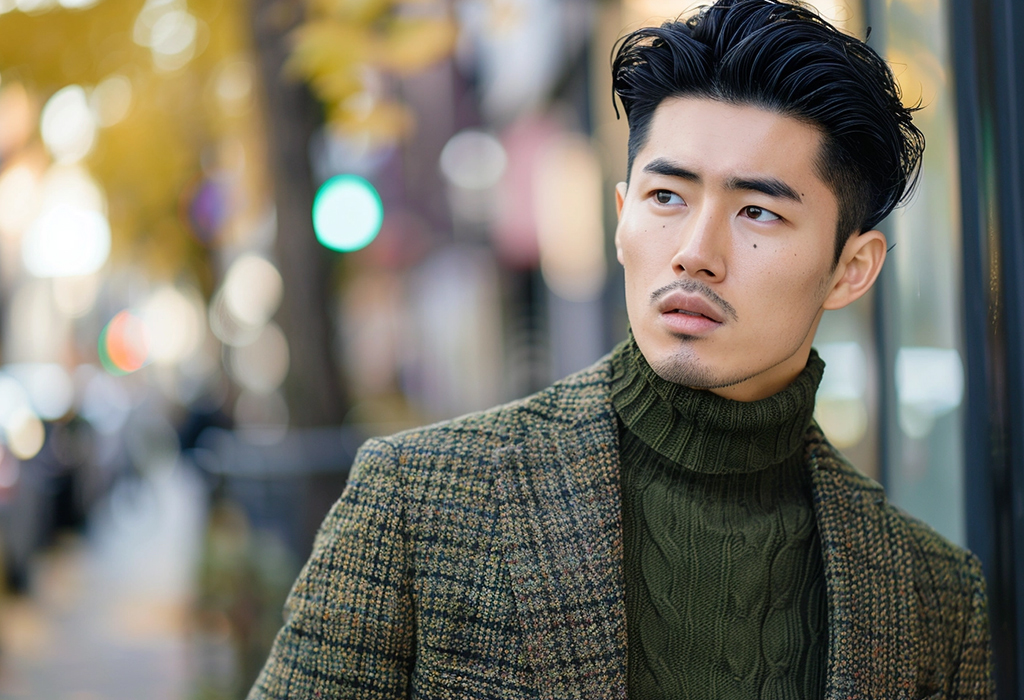
This extends to bottoms, as well. Try swapping your regular work chinos for a pair of tailored trousers to elevate your ensemble. This can work any time of the year if you go with the right fabric. Try wool or corduroy for fall and winter, cotton for spring, and linen or seersucker for summer!

Looking to try a bit more? Wear a full suit!
Until the late 1990s, it was more common than you might think. Hence, the vintage association. If you have the option, opt for more casual suiting made from casual fabrics like tweed, corduroy, or linen. When the occasion calls for it, smoother, worsted wools should be your go-to for business or more formal settings.
Tip #3: Try Out New Silhouettes
A lot of modern, contemporary clothing has fit very similarly for a while now. Slim and skinny fits were all the rage in the 2010s. Even today, it remains a very common style. For the fashion-conscious, wider, roomier fits have been back for a few years now. But if you have yet to give it a try, maybe now’s the time!
Not all larger fits are the same, either. For example, during various decades across the twentieth century, the fit of pants, in both refined tailoring or casual workwear, was constantly evolving, much like our trends today.
The 1920s brought high-waisted, full-cut trousers — Oxford bags were the extreme version. The 1930s and ’40s added the drape cut: a full chest, a roomy jacket, and wide-legged pleated trousers. In the 1970s, flared pants were accentuated with a slimmer thigh. Big shoulders in jackets and a tasteful excess of fabric characterized much of the look of tailoring in the 1980s.

If you’ve been wearing the same slim or skinny fit chinos and slim fit suits since 2010, it might be time to switch things up! There will always be a place for tasteful slim fits, but it can be a lot of fun to experiment with roomier clothes, too.

Here’s a quick cheat sheet for the decades most guys pull from. Read the last column first — it’s the one-era-piece rule applied to each decade.
Vintage Decades Cheat Sheet
What each era looked like, who it flatters, and how to wear it today
Every decade had exceptions — these are the looks most guys borrow. Fit to your body always wins.
Want to go deeper on a single era? Read our guides to 70s fashion, 80s fashion that still works, and 90s-inspired outfits.
Tip #4: High-Rise Pants Are Iconic
Sometimes, a low-rise jean looks pretty cool! The Ramones certainly had the right idea. But for a good chunk of menswear history, pants have traditionally sat significantly higher on the waist, falling closer to one’s natural waistline.
The rise of a pair of pants refers to how much fabric exists between the top of the waistband and the crotch seam. The more fabric, the higher the rise.
Aside from lending your outfits a classic, vintage look, high-rise pants can actually make you look taller by elongating your legs and breaking up your body proportions in a way that is almost always universally flattering to all body types.
With the right amount of room in the seat, sometimes afforded by pleats (see tip #6), they can be highly comfortable, and typically slip a lot less than many lower-rise pants.

Generally speaking, high-rise pants extend to around your belly button. But sometimes, they can be a little higher or a little bit shorter. Finding which exact fit is right for you can take some trial and error, but a good pair of high rise jeans or tailored trousers are a great way to give your outfits a vintage touch.
Tip #5: Frame Your Face With Retro Shades
There are tons of sunglasses with timeless, classic frames that stand the test of time. But if you want to make a statement, go bold! Big shades in tinted colors offer a lot of 70s appeal.
Tortoiseshell sunglasses have a bit of a softer touch, but work well with all sorts of classic menswear aesthetics.

Maybe you’re going for a 1980s stockbroker look? Keep things big, bold, and boxy! A good pair of vintage style shades can be a brilliant capstone on an already brilliant retro outfit.
Tip #6: Pleated Pants, Perchance?
One of the chief characteristics of classic menswear and vintage tailoring is the amount of depth and dimension afforded by the fabric, fit, and details.
Today, a lot of contemporary fashion can feel a bit flat. But if you keep an eye on the forefront of fashion, you may have observed that pleated pants have made quite the comeback in the past few years!
And for good reason, too. Gone is the somewhat dorky, dad-like association of ill-fitting, pleated khakis. Quality pleated pants lend an extra dose of visual interest to all types of outfits, from casual linen trousers to the most refined tailoring.

Flat-front pants are just fine, but pleats offer a subtle yet noticeable charge of detail and dimension. They afford pants a bit more shaping, and as you very well know by now, silhouette is vital to getting a vintage look right.
And they can be practical, too. If you happen to have thicker thighs, you’re likely to enjoy the added comfort and room of pleated pants. A little pleat goes a long way!
Whether you prefer a single, reversed pleat, double, forward-facing pleats, or a different configuration, like double reversed pleats, they’re guaranteed to signal that your outfit considers classic detailing.
Tip #7: It’s Time For Ties
Modern menswear seems to be rather split on the necktie. Many have all but abandoned it, even at traditionally formal events like weddings or political forums. Others still maintain that traditional tailoring almost always required a tie.
Regardless of where you fall, the tie has certainly become less and less popular over the twenty-first century. But for most of classic menswear history, the tie has held a place across many shapes, forms, and aesthetics. And if you’re trying to go for a vintage look, the right neckwear can make a big difference.

Classic silk ties in simpler patterns will work best for formalwear, whereas bolder ties are more of a statement piece. Textured ties, such as knits or wool compositions, can really add to an ivy or academic look. Wider ties tend to be seen as more vintage – but bear in mind that skinnier ties were popular in the late 1950s and 1960s!
To stand out and really sell a vintage ensemble, it might just be time to revisit the necktie.
Tip #8: Prioritize Natural Fabrics
With the exception of 1970s style, which popularized polyester in the form of double-knit synthetic suits for leisure, disco, and more, vintage style is often entirely composed from natural fiber fabrics.
Today, a lot of modern clothing is made from polyester or other synthetic fabrics. This changes how a garment feels, wears, and lasts. Vintage clothing is often made entirely from natural fabrics like wool, cotton, and linen.

Unless you’re going for a 70s look, polyester or synthetic-blend clothing is often a staple of more modern clothing. A suit made from stretch-infused athleisure fabric might be comfortable, but it won’t exactly communicate a vintage style.
Prioritizing natural fabrics will ensure that most of your outfits read as more period-accurate, and they’ll likely last longer, as well.
Tip #9: Vintage Bling Counts, Too
Vintage jewelry can be a great finishing touch to your outfit, and an even better way to express your individuality. Like authentic vintage clothing, you often can’t beat the genuine article when it comes to antique jewelry.
Necklaces, rings, bracelets, and more, can often be found at flea markets or online marketplaces for competitive price points. Where you can, try to stick with genuine silver or gold. In the long run, it’ll often look a lot better than some cheaper alternatives.
Nervous about trying out jewelry? Start small!
A simple chain, pendant, or ring is an easy access point to experiment. Historically, rings have many hidden meanings and old-world associations, often depending on the finger you choose to wear them on. For an easy vintage look, a simple signet ring will most likely suffice.

Signet rings are adorned with seals, often bearing a family crest, signature, or similar, used to confirm authority on documentation and the like. Today, they just look great as a top-tier vintage accessory.
Tip #10: These Shoes Are Made For Walking
Don’t discount your footwear! When it comes to putting together an outfit, your shoes will sometimes be the first thing people notice, and they can truly make or break your overall look.
For more casual outfits, consider timeless classics such as Converse Chuck 70s, brown leather derbies, loafers, or even a western boot.

For more formal styles, choose true dress shoes: oxfords in black or dark brown. Unlike open-laced derbies, they use a closed lacing system that looks sleeker and more polished.
If you’re interested in investing in quality dress shoes, consider goodyear welted shoes and full-grain leather. These may cost more up-front, but they’ll age more gracefully, too, and can typically be expected to last longer.
Tip #11: Tailor Every Vintage Find

Here’s what the thrift haul videos don’t tell you: vintage size labels lie. A 40R jacket from 1965 was cut for a different body than a 40R today, and decades of washing, dry cleaning, and previous alterations have changed plenty of old garments since they left the factory. So shop with a tape measure, not the label.
Before you go, measure a jacket and a pair of trousers that already fit you well: shoulder width, chest (pit to pit), sleeve length, trouser waist, and inseam. Write the numbers in your phone. Then measure the vintage piece and compare. Two minutes with a tape saves you from a bad buy.
Then plan on a trip to the tailor. A good tailor can take in or let out a waist, hem trousers, shorten sleeves, and slim a jacket’s body. What he can’t easily fix is the shoulders — if they don’t fit, walk away, no matter how good the fabric is. Check inside old trousers, too. Many have an inch or more of extra seam allowance in the seat and waist, which makes them easy to let out. Not sure what alterations should cost? Our alterations price guide breaks it down.
This is the step most guys skip, and it’s why their vintage finds end up hanging in the closet. A cheap thrift-store tweed jacket plus a visit to your tailor will look better than an expensive jacket off the rack that doesn’t fit. Fit beats everything — vintage included.
Tip #12: Finish With A Classic Haircut

You can nail every piece of clothing in this article and still look modern from the neck up. Your hair and facial hair frame the whole outfit, so they need to match it.
The easiest vintage haircut is the classic side part: short on the sides with a taper, longer on top, combed to one side with a light-hold pomade or cream. It looked right in 1950 and it still looks right today. It’s what I wear, and it’s the most forgiving classic cut there is. Ask your barber for “a classic taper with a side part” and bring a photo.
- 1940s–50s: a side part or a short pompadour, clean-shaven or a pencil mustache.
- 1960s: the Ivy League cut — short, neat, and easy to comb.
- 1970s: longer and fuller, with a thick mustache or full sideburns.
Same rule as the clothes: one era signal at a time. A pencil mustache with a drape-cut suit and a fedora is a costume. A clean side part with that same suit looks sharp. For more cuts, see our list of classic hairstyles for men, and if you’re thinking about facial hair, here are the main mustache types.
Bonus Tip: Don’t Forget to Have Fun with the Process
Thought we were done, did you? Well, we nearly are.
But it’s worth noting that the most important part of experimenting with style, vintage or not, is to allow yourself to enjoy the process.
If you start to feel frustrated that your outfits aren’t looking exactly the way you pictured in your head – that’s okay! Fashion and style journeys are rarely completed in one trip. So, be sure to experiment. Learn. And enjoy yourself along the way!
Vintage Look Questions Men Ask
How old does clothing have to be to count as vintage?
The common rule is 20 years. Anything 100 years or older is antique. New clothing made to look old — reproduction denim, a modern brand’s 1940s-style trousers — is called retro or vintage-inspired. For getting the look, any of them works. For quality, true vintage often wins because it was made from natural fabrics (see Tip #8).
Can I mix pieces from different decades?
Yes — as long as only one piece shouts its decade. A 1960s Harrington jacket with straight jeans and plain leather sneakers works because the jeans and sneakers are quiet. Two loud pieces from two different decades fight each other.
Can vintage suits be altered?
Most can. Waists, hems, sleeves, and the jacket body are routine work for a good tailor, and older suits often have extra seam allowance built in. Shoulders are the exception — get those right when you buy. For the details, read our guide on getting a suit jacket altered.
Is vintage clothing better quality than new clothing?
Not automatically. Every decade made plenty of cheap clothing — most of it just didn’t survive. What you find on the rack today is the stuff that lasted, which is why vintage can feel better made than the mall. Judge each piece on its own: check the fabric tag, the stitching, and the lining before you pay.