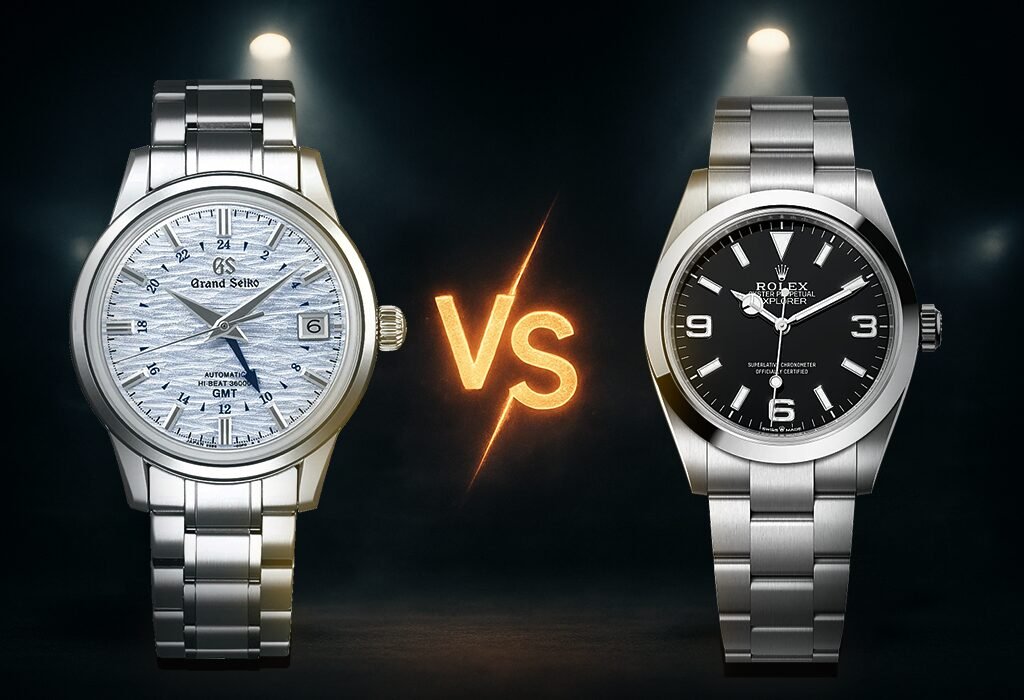

Ask most men to name the world’s top luxury watch.
Chances are, they’ll say Rolex.
But what if I told you there’s a quieter, humbler master watchmaker from Japan — a brand so obsessive about precision that the Swiss observatory trials were cancelled right after it started crowding the leaderboard?
Meet Grand Seiko. The brand that told physics to shut up — and delivered the world’s most mind-bending mechanical watches anyway.
So let’s settle the Grand Seiko vs Rolex question. Below you’ll get the story of how Grand Seiko rattled the Swiss establishment, 10 reasons some watch connoisseurs say it outshines Rolex — and, to be fair, the places where Rolex still wins. I’ve owned both, so I’ll tell you which one I’d buy and why.
The Story That Changed Watchmaking
Let’s rewind to the 1960s.
Switzerland ruled the world of watchmaking, crowned each year through the Observatory Trials — elite competitions measuring who could build the most accurate mechanical movements.

Then came Seiko with two rival in-house teams: Daini Seikosha (the King Seiko side) and Suwa Seikosha (the Grand Seiko side). At the 1967 Neuchâtel trials, Daini and Suwa finished second and third in the manufacturer rankings — behind only Omega. By 1968? At Geneva, Seiko took fourth through tenth place in the wristwatch category. The only movements ahead of them were Swiss quartz prototypes.
Then the trials stopped.
Neuchâtel cancelled its 1968 contest for good, and Geneva shut its own down soon after. Nobody official ever blamed Seiko. But the timing tells you how close the Japanese had come.
Reason #1: A Craftsmanship Obsession Swiss Brands Can’t Match

Ever heard of Zaratsu polishing?
Most watch brands machine-finish their steel cases. Grand Seiko’s master polishers press each case by hand against a spinning tin disk — a method Seiko adopted in the early 1950s from German Sallaz machines (that’s where the name comes from) — to create a flawless, distortion-free mirror finish.
The result? A case that reflects light so sharply it makes your Rolex Submariner look dull by comparison.
Reason #2: Innovation You Can See (And Feel)

Grand Seiko doesn’t just perfect traditional watchmaking — it reinvents it.
Take the Spring Drive movement: it combines the soul of a mechanical watch with the accuracy of quartz. Instead of ticking like a standard movement, the seconds hand glides in a perfectly smooth, silent sweep. No Swiss brand does this.
Reason #3: Hi-Beat Movements That Push the Limits

Most mechanical watches beat at 28,800 vibrations per hour (vph). Higher frequency means better accuracy — but more friction, less power reserve.
Grand Seiko’s engineers refused to accept that trade-off. Their newest Hi-Beat 36000 caliber, the 9SA5, runs at 36,000 vph and stores 80 hours of power reserve. And they’ve been building hi-beat watches since 1968. Rolex only joined the 5 Hz club in 2025, with the Land-Dweller.
Reason #4: Japanese Steel That Laughs at Rust

Rolex uses Oystersteel — its own version of 904L stainless steel, tough and corrosion-resistant.
Grand Seiko developed Ever-Brilliant Steel — with a Pitting Resistance Equivalent Number over 40 (904L sits around 35), meaning it stays bright and shrugs off corrosion better than almost anything else on your wrist. Grand Seiko only uses it on select models, so check the spec sheet if it matters to you.
Reason #5: The Dials Are Tiny Works of Art

Swiss watches are beautiful. But Grand Seiko takes dial design to an artistic level.
Their famous “Snowflake” dial mimics freshly fallen snow on the Shinshu mountains. Their “ShoSho” summer dial ripples like light reflecting on water. Photos don’t do them justice — you have to see one in sunlight to understand.
Reason #6: Unique But Accessible

Rolex is iconic — but also everywhere. Walk into a luxury bar, and you’ll spot at least two Submariners.
Grand Seiko is rarer. It’s a signal you know your horology. And unlike a Rolex Daytona that takes months (or years) to get at retail, Grand Seikos are more readily available — no backdoor games or inflated resale prices.
Reason #7: Transparent Movements

Love seeing watchmaking mastery at work? Grand Seiko often uses see-through casebacks. Rolex almost never does — only the 1908 and the new Land-Dweller show off their movements.
With a Grand Seiko, you get to admire the finely decorated bridges and rotor, hand-finished to near perfection.
Reason #8: More Watch for Your Money

Dollar for dollar, Grand Seiko gives you more hand-finishing, more movement, and more dial than almost anything coming out of Switzerland.
And the pre-owned market tilts even further in your favor. Most used Grand Seikos sell well under retail. That hurts the first owner — and helps you. A pre-owned Snowflake (SBGA211) has been trading around $4,400: Spring Drive, a titanium case, and that famous dial for less than most used steel Rolexes. Just know Grand Seiko wants a service every three to four years. More on that below.
Reason #9: Understated Prestige

A Grand Seiko doesn’t shout. It whispers quality to those who know.
Collectors describe it as “stealth wealth” — subtle brilliance, noticed only by true enthusiasts.
Reason #10: The Most Accurate Quartz Watch You Can Buy

Rolex doesn’t sell a quartz watch anymore. Grand Seiko builds what a lot of collectors call the best quartz movement in the world — the 9F.
A typical quartz watch is accurate to about 15 seconds a month. The 9F is rated to ±10 seconds a YEAR. It’s assembled by hand, and the seconds hand lands dead-center on every marker — something cheap quartz watches never get right. (Fuzzy on how the two work? Here’s my breakdown of quartz vs. mechanical watches.)
Here’s how the accuracy specs stack up:
- Grand Seiko 9F quartz: ±10 seconds per year
- Grand Seiko Spring Drive: ±15 seconds per month (about half a second a day)
- Rolex Superlative Chronometer: ?2/+2 seconds per day
- Grand Seiko 9S mechanical (like my SBGJ249): +5/?3 seconds per day
So on a pure mechanical, Rolex’s spec is tighter — I’ll give them that. But Grand Seiko gives you three ways to tell time, and two of them are more accurate than anything Rolex makes. If you want a grab-and-go watch you never wind and rarely set, the 9F is the smart buy.
Where Rolex Still Wins

Perfection isn’t free from quirks.
Some Grand Seiko models — my own SBGJ249 included — are rated to just 30m of water resistance. Some lack lume (glow-in-the-dark hands). And their bracelets can feel less luxurious than Swiss rivals.
Then there’s the money side. Here, Rolex wins clearly.
Resale. Popular steel Rolexes still hold their value or sell above retail on the secondary market. Most pre-owned Grand Seikos sell for roughly 35–40% under retail. If you think you might sell, that gap is real money.
Service intervals. Grand Seiko recommends a service every three to four years. Rolex is generally quoted at about ten. Over twenty years of ownership, that’s several extra trips to the watchmaker — and the bills that come with them.
Recognition. Nobody needs a Rolex explained to them. Wear a Grand Seiko and most people will assume it’s a regular Seiko. That’s either a downside or the whole point, depending on why you’re buying it.
Bracelets. Rolex’s Oyster bracelet, with clasps you can adjust on the fly, is hard to beat. Grand Seiko has improved here, but it’s still the gap owners mention most.
But ask owners if they regret choosing one? Most say they’d buy again — in a heartbeat.
Which Grand Seiko Matches Which Rolex?

Cross-shopping? Here’s how the two lineups match up, model for model.
Rolex Datejust vs. Grand Seiko Snowflake (SBGA211). The classic do-everything watch. The Datejust has the fluted bezel everybody recognizes. The Snowflake has the textured white dial, the Spring Drive sweep, and a titanium case that’s noticeably lighter on the wrist. Both work with a suit on Monday and a polo on Saturday.
Rolex Explorer vs. Grand Seiko White Birch (SLGH005). Clean, simple, three-hand steel watches. The Explorer is the tool-watch legend. The White Birch is the finishing showcase — and it runs the 80-hour 9SA5 from Reason #3.
Rolex GMT-Master II vs. Grand Seiko GMT. Rolex wins on the rotating bezel and the icon status. Grand Seiko’s Hi-Beat and Spring Drive GMTs are the dressier take — mine is one of them.
Rolex Submariner vs. Grand Seiko Spring Drive Diver. The Submariner is rated to 300m and is the most copied watch on earth. Most Grand Seiko Spring Drive divers are rated to 200m and wear bigger and heavier — try one on before you buy.
Here’s the whole Grand Seiko vs Rolex comparison at a glance:
Grand Seiko vs. Rolex at a Glance
Where each brand wins — the honest version
Specs are brand-rated tolerances; resale and availability shift with the market (checked November 2026).
I Own Both: My Grand Seiko vs. My Rolexes

When I traveled to Japan, I knew I had to get one. I chose the Hi-Beat GMT SBGJ249 — a piece that reminds me of summer in Japan every time I check the time.
The dial? Like sunlight dancing on water.
The accuracy? Unreal.
No lume? Who cares. It’s perfect.
But don’t read this as anti-Rolex. I’ve owned an Explorer, a Submariner, a Yacht-Master, and a Datejust 41. Here’s what owning both brands has taught me.

Fit comes first. My SBGJ249 is 39.5mm; the Datejust is 41mm. Diameter isn’t the whole story, though — check lug-to-lug length. If the lugs hang past the edges of your wrist, it looks like you borrowed your dad’s watch, no matter whose name is on the dial.
Know who you’re dressing for. A Rolex gets noticed by everyone. A Grand Seiko gets noticed by the right people — the guy who knows watches and asks what you’re wearing. That quiet confidence is why it keeps showing up on old money watch lists.
My rule: If there’s any chance you’ll sell the watch in five years, buy the Rolex. It holds its money. If you’re buying a watch to wear for twenty years and hand down to your son, buy the Grand Seiko. It’s more watch for the money — and you’ll never care what it’s worth.
Grand Seiko vs Rolex: Quick Answers
Is Grand Seiko a luxury brand?
Yes. Grand Seiko has been its own brand since 2017, when Seiko spun it off and took the Seiko name off the dial. Prices start at a few thousand dollars for quartz and run well into five figures for precious-metal pieces — and the finishing competes with Swiss brands that cost far more.
Is Grand Seiko the same as Seiko?
Same parent company, different watches. Grand Seiko launched in 1960 as Seiko’s best-of-the-best line. Today it has its own movements, its own studios, and its own boutiques. Want the regular Seiko lineup? Start with my Seiko watch buying guide.
Does Grand Seiko hold its value?
Not like Rolex. Most pre-owned Grand Seikos sell for roughly 35–40% below retail, though some limited editions do better. Bad news if you plan to sell. Good news if you buy used.
Is Grand Seiko better than Rolex?
On finishing, dials, and movement variety, a lot of collectors say yes. On resale, recognition, and bracelets, Rolex wins. The better watch is the one that matches why you’re buying it.
Final Verdict: Should You Pick Grand Seiko Over Rolex?
If you crave the world’s most recognized luxury status symbol — get a Rolex.
If you want a masterpiece that blends handcraft, cutting-edge tech, and quiet elegance — pick Grand Seiko. The Swiss know why they can’t compete.
Still torn? Go back to my rule: might sell it someday — Rolex. Keeping it forever — Grand Seiko.