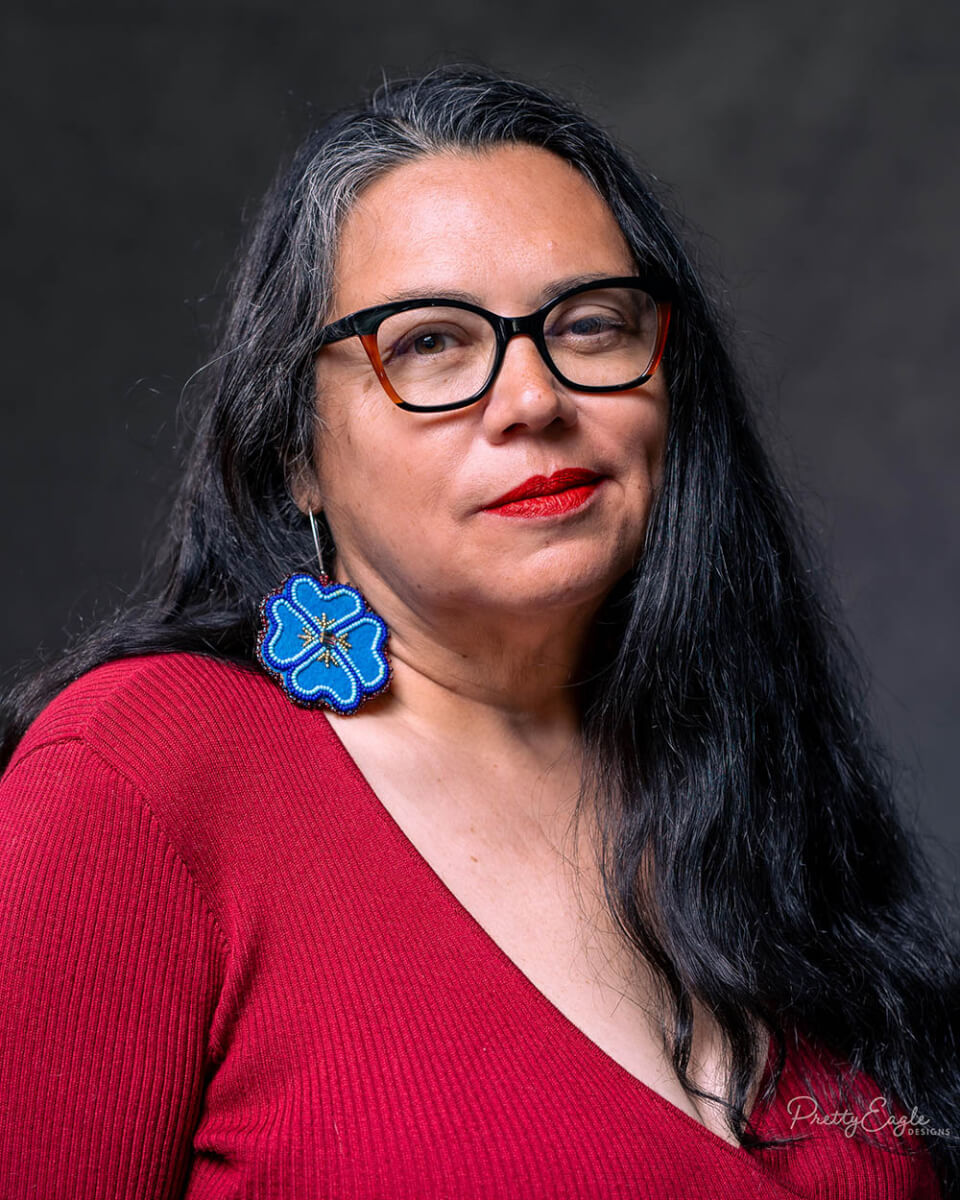
Andrea L. Rogers, a citizen of the Cherokee Nation and author of the Caldecott Award-winning picture book Cooch Helped, illuminates the injustices perpetrated upon her Native people through the goings-on of 12-year-old Cynthia, the daughter of an interracial couple, in her historical middle grade novel. In the summer of 1968, Cynthia and her family move from Texas to her white grandparents’ ranch in Oklahoma. There, she decides to learn more about her and her mother’s Cherokee heritage, and she begins to wonder if a Native girl, Violet Wood, may have been murdered for the stolen land that her father’s family now occupies.
This is a book about siblings, as is Cooch Helped. How have your own experiences with siblings affected your writing—as well as your worldview?
I have a younger sister and brother that I’m so grateful for. Though when I was 12 and felt responsible for them, I was often annoyed. My sister is two years younger than me, and, in many ways, we were all each other had when we walked into school and were the only phenotypically Cherokee people in the building.
When I was a kid, there were few books about contemporary Native people and families. As a Cherokee reader, I had to squeeze myself and my family into stories that didn’t fit. I read all the books by Judy Blume and Beverly Cleary. These were beautiful, comforting stories about family and growing up, but they didn’t include us or reflect us or Cherokee culture. When I had my first child 30 years later, the landscape had barely changed. I have been working on this story since 1994, and my original driving idea was to show a perfect family who loved one another even though they had their own things going on, because I wanted a Cherokee Judy Blume growing up. However, the longer I parent, teach and live, I see how easily loss, estrangement and misunderstanding happen. It’s really easy for us to take our siblings, children and parents for granted. I wanted to remind myself to appreciate the gift and tend to it.
The first chapter of Death in the Tallgrass begins with a somewhat spooky encounter and a reference to a “skilly”—a ghost. Have you ever seen a ghost? How did your interest in the supernatural evolve?
In college, my husband and I once rented a house in Tulsa that was haunted. What’s funny is my husband didn’t believe in the supernatural. Yet, he actually experienced this happening first and didn’t tell me. He wrote about it in his journal. Then a similar spooky thing happened to me. When I told him, he showed me and a friend the entry. It was pretty scary. We moved out shortly after that.
I do think people and places are haunted by misdeeds and injustice. I believe that we have to actively work for justice and restoration for that negative energy to dissipate.
And I believe our ancestors are always around, but not in a bad way.
Cynthia and her family are displaced in this novel, as they move from Dallas to Oklahoma and stay with her grandparents. During this unsettled time, Cynthia witnesses events that tear her family apart. How does resilience factor into your books, especially in the wake of history seeming to repeat itself with estrangement in Cynthia’s family?
Thanks for pointing that out! That was not my intention when I first sat down to write this book. The year 1968 was fraught. I have so much respect for leaders who risked their lives for racial and economic justice. So many advances we (until recently) took for granted only happened because of protests, boycotts, political action and true, life-threatening allyship. I researched the heck out of Tulsa, Dallas, Oklahoma and the United States in that period.
So many of us believe we would always act in a way that aligns with our values until those values are tested. Complying with unjust power may seem the smart and advantageous course, but there’s a cost. For me, as a parent, losing a relationship with my child would never be worth safety.
Has writing a Caldecott winner—Chooch Helped—changed your writing, or your life?
I always wanted to be a writer. My librarians were great about sharing award-winning books. So, my goal was to win all the awards, eventually. I thought that would mean I was a capital R, Real writer. I didn’t know the Caldecott was awarded to the illustrator! But I am so glad it is. Rebecca Lee Kunz’s work is worthy of the most important picture book award out there. I truly believe picture books are one of the highest art forms dedicated to the joy of children.
As for change, I guess I don’t know yet. I’m invited to more events. When I meet strangers and they ask the inevitable “Would I have read anything you’ve written?” it’s statistically possible they may have. I’m so happy that Chooch lives in so many places because of it. The biggest life change is that I now introduce my brother as Chooch and my sister as Sissy in bookstores and libraries, and people laugh. It’s funny, because it’s true.
Cynthia and her sisters are desperately trying to learn more about their heritage. In an afterword, you note that “there is a distinct lack of work about more contemporary Cherokee history.” What advice do you have for readers trying to understand their own family history?
Trust but verify. My non-Native grandma grew up in Canada and California, and her family was convinced they were Blackfeet in hiding. When people saw her or my mom, they assumed they were Native. They’re not, though. They’re Eastern European, and the documentation and historical record reflect that. The reality is, for the most part, people who looked Native in the late 1800s were not allowed to hide. When your neighbor wants your house, you’re never safe.
One thing I love to do is read old newspapers. I’ll find the most random information that pertains to my relatives and community. It gives you a tiny window into what life was like for them and their community. Apparently, at one point, my Grandpa Rogers and his half brother worked making baseball bats; it was in the local paper, which has since been digitized.
“I do think people and places are haunted by misdeeds and injustice. I believe that we have to actively work for justice and restoration for that negative energy to dissipate.”
Violet’s bracelet and diary reach out to Cynthia and her sisters like a telegram from the past. Was Violet inspired by a real person?
Violet was inspired by the children who were victims of the guardianship programs that greedy people used to take what they wanted from Native people and Freedmen (the formerly enslaved). My husband was doing research at the small Oklahoma museum he worked at and had been reading congressional testimony about guardians either refusing to seek medical care for their wards or worse (being the reason their wards died). He read me some of the transcripts, and it broke my heart. It took me almost 30 years to finally write about it in a way that felt true, even though my book is definitely historical fiction.
We currently live in Mountainburg, Arkansas. When we were looking for a home, I didn’t know anything about the area other than it was part of the Osage homelands and hunting grounds at one time. I was out of town, and my husband sent me the listing after he looked at it. We made an offer on it based on how it felt. Turns out, Cherokee people lived there after the Osage were forced to give it up. Then my people were forced out. Our house sits on one of the roads they were forced to travel to Indian Territory.
You write moving books that seem to speak directly to your readers. Can you share any memorable interactions with or questions from fans?
There have been so many. I’m so grateful to be in conversation with the hearts and brains of readers. I’ve had parents tell me their kids say, “I helped like Chooch!” One of my paid beta readers shared this book with their partner, who was also historically impacted by the post-statehood greed and graft, and they said, “I wish I had had a book like this when I was a kid.” Another reader in New York pulled me aside and said, Man Made Monsters changed my life. And she seemed really happy about it. I’m so grateful to do this work.
What do you hope Native and non-Native readers take away from Death in the Tallgrass?
This is by far the hardest question! My wonderful editor, Nick Thomas, asks me this when I’m struggling with the end of my stories. And now, I ask my students the same thing. It’s so hard because we all read the same book differently.
I hope people set the book down and do something for someone they love. I hope they remember to nurture those relations and community ties. I hope they learn something new about something they are curious about. I hope they read more books by Native writers.
Most importantly, I hope they leave snakes alone. Not everything that scares you is a monster.
Photo of Andrea L. Rogers © Erica Pretty Eagle.