You look at yourself in the mirror.
Suit looks great.
Shirt looks awesome.
Now the question…
Tie? Or no tie?

It’s a harder question than it seems.
Everyone else will be wearing one.
But you’re not a tie guy.
And does your shirt collar really look great without a tie?
Gentleman, in today’s article, I am going to address those questions.
In addition, I am going to give you 5 points on how to wear a suit, sports coat, and blazer without a tie and look like a million bucks.
Note: A suit is when a jacket and trousers are made of the same fabric. Many modern gentlemen are wearing sports coats or blazers and generally the rules still apply.
For this article, I am going to use the terms jacket, sport coat, blazer and suit interchangeably.
Suit Without Tie #1: Read The Room Before You Ditch The Tie

An accurate environment is everything.
Certain environments require certain aesthetics. Choosing to not wear a necktie might not be viewed favorably and could have a severe penalty. For example, certain high-end restaurants require a jacket and tie or your work environment might dictate that the necessary uniform requires neckwear. Think about the situation.
In any case, make sure to research where you are going before you get there. Be thorough and exhaustive because sticking out like a sore thumb because you’re not in the proper attire would be beyond embarrassing.
If you dig around and still can’t get a straight answer, make the call and commit to it. Here’s the thing — nobody in that room is running a checklist on your neckline. What they pick up on is whether you look like you meant it.
A man who decided how he’s dressed and then forgot about it moves completely differently than a man spending the whole night tugging at his collar wondering if he got it wrong. People read that posture long before they audit your shirt.
Suit Without Tie #2: The Shirt Collar Is Doing All The Work
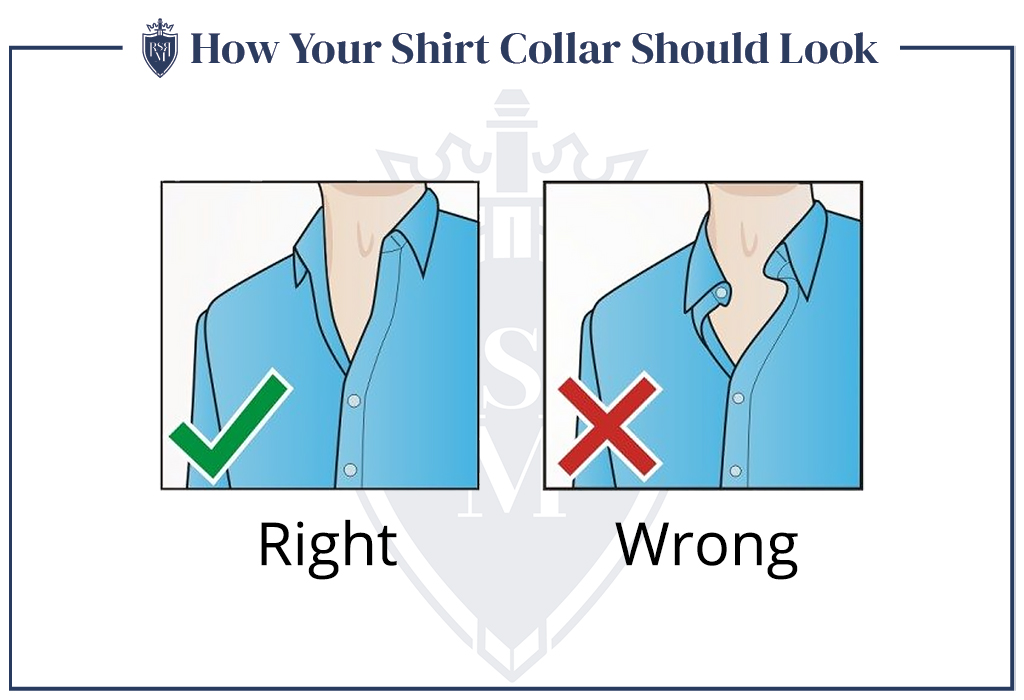
Without a necktie, your collar is what frames your face. It helps give definition to your chin and neckline. What’s going to help make this frame is the placket of the shirt. I go into more detail here but the simple definition of a placket is the panel where the buttons and buttonholes are located.
As our friends over at Million Dollar Collar point out, the placket of a dress shirt is not strong enough to sustain the weight of the collar. So the result is a gaping, flimsy collar that doesn’t look crisp or adequately frame your face. They’ve developed a permanent way to reinforce the placket so that the collar flop doesn’t happen.
After you solve the placket issue, it’s on to the collar. Ways to make the collar taut are:
- Make sure it’s ironed – This should be a no-brainer but you’d be surprised. Don’t be afraid to add some spray starch to the collar before ironing to give it some extra rigor.
- Put removable plastic, metal or magnetic collar stays in the collar.
- If possible, budget in dry cleaning and get your shirts lightly or heavily starched.
Here’s what most guys miss, though. Everything above is treatment — starch, stays, a good press. It helps. But the collar STYLE matters more than anything you do to it. You can starch a soft point collar until it crackles and it will still fold into your lapels the second you turn your head.
Understand what the necktie was actually doing up there. The knot wedges in between the collar points and props them apart, like a keystone. Pull it out and the collar has to stand on its own — which means the spread, the length and the interlining all have to be up to the job. Some collars are built for it. Most aren’t.
Which Shirt Collars Work Without A Tie (And Which Ones Flop)

Pull every dress shirt you own out of the closet and run it against this. Five minutes, and you’ll know which ones are open-collar shirts and which ones are hostages to a necktie.
#rmrs-cmp-collar *{box-sizing:border-box;margin:0;padding:0;}
#rmrs-cmp-collar{
–navy:#14213d; –navy2:#1f335c; –cream:#faf6ec; –cream2:#f1e9d6;
–gold:#c9a24b; –ink:#2a2a2a; –line:#e2d7bd;
font-family:-apple-system,BlinkMacSystemFont,”Segoe UI”,Roboto,Helvetica,Arial,sans-serif;
color:var(–ink); max-width:760px; margin:32px auto; padding:0 4px; line-height:1.5;
-webkit-font-smoothing:antialiased;
}
#rmrs-cmp-collar .cmp-title{
text-align:center; color:var(–navy); font-size:22px; font-weight:800;
letter-spacing:.2px; margin-bottom:4px;
}
#rmrs-cmp-collar .cmp-sub{
text-align:center; color:#6b6250; font-size:13px; margin-bottom:18px; font-style:italic;
}
#rmrs-cmp-collar .cmp-scroll{overflow-x:auto; -webkit-overflow-scrolling:touch;
border-radius:12px; box-shadow:0 6px 22px rgba(20,33,61,.12);}
#rmrs-cmp-collar table{
width:100%; border-collapse:collapse; background:var(–cream);
min-width:520px; font-size:15px; overflow:hidden; border-radius:12px;
}
#rmrs-cmp-collar thead th{
background:var(–navy); color:#fff; padding:16px 14px; text-align:left;
font-size:16px; font-weight:700; vertical-align:middle; border:none;
}
#rmrs-cmp-collar thead th.cmp-attr{background:var(–navy2); width:26%; font-size:13px;
text-transform:uppercase; letter-spacing:.6px; color:var(–gold);}
#rmrs-cmp-collar thead th .cmp-house{display:block; font-size:12px; font-weight:600;
color:var(–gold); text-transform:uppercase; letter-spacing:.6px; margin-top:2px;}
#rmrs-cmp-collar tbody th{
background:var(–cream2); color:var(–navy); font-weight:700; text-align:left;
padding:12px 14px; font-size:13px; text-transform:uppercase; letter-spacing:.4px;
border-top:1px solid var(–line); width:26%; vertical-align:top;
}
#rmrs-cmp-collar tbody td{
padding:12px 14px; border-top:1px solid var(–line); vertical-align:top;
color:var(–ink);
}
#rmrs-cmp-collar tbody td:first-of-type{border-left:1px solid var(–line); width:20%;}
#rmrs-cmp-collar tbody tr:nth-child(even) td{background:rgba(201,162,75,.06);}
#rmrs-cmp-collar .cmp-badge{
display:inline-block; font-size:11px; font-weight:800;
text-transform:uppercase; letter-spacing:.5px; padding:3px 9px; border-radius:999px;
background:var(–gold); color:#3a2c07;
}
#rmrs-cmp-collar .cmp-badge.alt{background:var(–navy); color:#fff;}
#rmrs-cmp-collar .cmp-badge.no{background:#8c2f22; color:#fff;}
#rmrs-cmp-collar .cmp-bottom th{background:var(–navy); color:var(–gold);}
#rmrs-cmp-collar .cmp-bottom td{background:var(–navy); color:#f4efe2; font-size:14px;}
#rmrs-cmp-collar .cmp-note{
font-size:12px; color:#8a8071; text-align:center; margin-top:12px; line-height:1.5;
}
@media(max-width:520px){
#rmrs-cmp-collar .cmp-title{font-size:19px;}
#rmrs-cmp-collar table{font-size:13.5px;}
#rmrs-cmp-collar thead th{padding:12px 10px; font-size:14px;}
#rmrs-cmp-collar tbody th,#rmrs-cmp-collar tbody td{padding:10px;}
}
| Collar Style | VerdictWorn open | WhyWhat actually happens |
|---|---|---|
| Semi-spread, fused | Your default | Wide enough that the points come to rest on your jacket lapels instead of sliding down between them. Make sure it’s fused or lined — a soft, unlined semi-spread folds like paper. |
| Button-down | Best in class | The only collar ever designed to hold itself up. Those two buttons are anchors, the roll looks deliberate, and it never gaps. Perfect with a sport coat or a softer suit. |
| Point collar, soft & unfused | Avoid | Long, narrow points built to be pinched together by a knot. Take the knot away and they collapse inward toward your sternum. This is the “I lost my tie somewhere” look. |
| Band / mandarin (no collar) | Great — different outfit | Nobody wonders where your tie went, because there was never anywhere to put one. Reads intentional. Pair it with unstructured, softer suits, not a pinstripe. |
| Cutaway / extreme spread | Risky | Cut wide to frame a big Windsor knot. Without one, the opening gapes and you end up showing a lot of chest and whatever undershirt you’re wearing. |
| Camp / Cuban collar | Summer only | Never with a worsted business suit. But with a linen or cotton suit in July, it’s one of the sharpest tieless looks going — the collar lies flat by design. |
| Knit or polo collar | Works, casual | Ribbed knit holds its own shape without any help. Best under an unstructured jacket. Under a structured business suit it reads like you got dressed in the dark. |
| Bottom line | Buying one shirt to wear open? Semi-spread with a fused collar, in a heavier cloth — a royal oxford or a twill, not a fine poplin. Heavy cloth stands up. Fine poplin folds over and quits. | |
Collar names vary by maker. When in doubt, hold the shirt up and see whether the collar stands on its own.
And here’s the two-second test that beats reading any label. Pick the shirt up and hold the collar by one point, letting it hang. If it flops straight over, that shirt needs a tie. If it holds an angle, you can wear it open.
Suit Without Tie #3: How Many Buttons Should You Undo?

Since the shirt is not bound by a tie you’re going unbutton the buttons of the shirt. It’s really preferential how many you should unbutton and there are few things to consider before making that decision. It comes down to your confidence level. Points to keep in mind are:
- The message it will send. The more buttons you leave undone, the more casual and daring the look reads. You want to be mindful of your environment, audience and the overall mood of the scene.
- The amount of buttons that are on your jacket. If your jacket has more buttons, it’s going to squeeze the shirt together tighter so the shirt’s opening will be closed and look less casual. This is the result of the high button keeping the lapels of the jacket close together and the stiff collar is leaning on those lapels. Conversely, if you are wearing a 1 or 2 button jacket, the opening of the shirt will be wider – giving a more casual look.
Now let me just give you the answer instead of leaving it up to preference. One button. One undone button is the default and it works everywhere — business suit, sport coat, blazer, all of it. It opens the collar enough to look deliberate and not so much that anyone’s looking at your chest.
Two is for a linen suit in July, a rooftop party, a date, a beach wedding — somewhere with a bar and no agenda. Three is a costume. Unless you’re playing a villain on a yacht, stop at two.
And here’s the detail nobody mentions: check it sitting down, not standing at the mirror. Sitting pulls the shirt open another inch. That’s how a two-button drop quietly becomes a three-button drop halfway through dinner.
Suit Without Tie #4: Keep Your Undershirt Hidden

Undershirts are important because they can:
- Insulate you
- Protect the dress shirt from body oils and sweat
- Help smooth the torso for a better fitting shirt
The general convention for wearing an undershirt is for it to not be seen. Remember that the open collar helps to frame your face and keep everything looking as streamlined and sleek as possible. Wearing the wrong type of undershirt can crowd the neck and give a bulky illusion. For this reason, wear a v-neck undershirt instead of a crew neck undershirt. The drop of the collar on a v-neck undershirt is perfect for maintaining that polished look.
One more on undershirts, and this is the one that trips guys up — color. Under a white or a light blue shirt, the white undershirt everybody buys is the wrong one. White under white shows through as a bright panel. You can see the neckline and the sleeve hems from across a room. A light grey, or a tan close to your own skin tone, vanishes. Hold the two up against your chest in daylight and you’ll see it in about a second.
Note: I am an advocate of trimming and controlling your chest hair. Again, this is totally up to you and based on your comfort level. In my opinion, this step is critical when exposing your neckline. Shaving completely is not necessary, but I recommend keeping it under control.
Suit Without Tie #5: Your Accessories Have To Work Harder Now

The necktie is an accessory that draws the eye in; it’s a focal point. Without the tie, your other accessories become more important. Your accessories such as
- Pocket square – As a generalization, the eyes draw to the face then downward. As such the pocket square is vital to keep the tieless suit as refined as possible. Many gents forego this critical accessory because they simply don’t know how to sport it. It’s really simple. Just get a plain white kerchief or pocket square, make a straight fold, and place it in your pocket with about ¼ to ½ an inch of the pocket square exposed. The compliments will be through the roof gents. Trust me!
- Cufflinks – Make sure that they are a pair that you are confident in and will make a statement. Be careful not to be too gaudy, but a fun pair or a set from granddad that have some history would be great.
- Watch – Your watch should complement your shoes and belt perfectly. The metal on your watch should match the metal on your belt buckle. If your watch is a leather band, the leather should be the same color as your belt and shoes. (This rule is must for any outfit).
- Lapel pin – With no tie, the lapel is bare real estate and a small pin fills it without shouting. Keep it small and keep it single — one pin, not a row of them. It should be the thing somebody notices second, not first.
- Shoes – Your shoes should be polished and shined. Whether it’s a whole cut, a brogue, a loafer is all depending on what you’re confident in wearing. The whole cut shoe (a shoe that’s made of a single piece of leather) is typically more elegant and refined so it will stand out more with a suit. A loafer will work well too because it’s a casual look. Loafers work especially well with lighter colored suits. However, any well polished, well-made dress shoe will work.
- Bracelets – This too is depending on your confidence level. Some gents opt to wear traditional metal bracelets while others go with leather, beaded stone, or a simple metal chain. The key with bracelets is restraint — one, maybe two, and stop there. Remember all metals should be the same on the whole outfit.
When You Should Keep The Tie On

Everything up to here is about doing the tieless thing well. This part is about knowing when not to do it at all. There are rooms where an open collar doesn’t read as style — it reads as a guy who didn’t take the day seriously. And the cost of getting that wrong runs a lot higher than the cost of being the one man wearing a tie.
- A job interview. Wear the tie unless you’ve confirmed the office is tieless, and honestly, even then. Being slightly overdressed costs you nothing. Being underdressed can cost you the job.
- A funeral. Wear the tie. This day isn’t about you.
- Court, or anywhere you’re standing in front of a judge. Same reasoning. You’re showing deference to an institution, not expressing yourself.
- Law, finance, insurance, government, old-line consulting. Watch what the room actually does for a few weeks before you decide the rules have changed. They change slower in these buildings than the internet says they do.
- Black tie, or a formal wedding. You are not skipping the bow tie. That’s not a tieless look — that’s an unfinished tuxedo, and everyone can tell.
- Any time the invitation names a dress code. Somebody sat down and wrote it out. Honor it.
- When the man who outranks you is wearing one. Client, boss, father-in-law. Match his level of formality or go one notch above it. Never below.
There’s one honest exception to all of this. If it’s your event — you’re the host, the founder, the man on the stage — then you set the dress code and the room adjusts to you. That’s real. Just make sure it’s actually true before you lean on it.
The Bottom Line On Wearing A Suit With No Tie
Skipping the tie isn’t the easy option. You’re removing the one accessory that was propping your collar up and pulling the eye toward your face, and that work has to go somewhere else. Into a collar that stands on its own. Into a pocket square. Into a suit relaxed enough that the whole thing reads as a choice.
Get that right and nobody wonders where your tie went. Get it wrong and it’s the first thing they notice.
Also read: Buying Second-Hand Suits – How To Spot Quality
The post How To Wear A Suit Without A Tie (Start With The Collar) appeared first on Real Men Real Style.