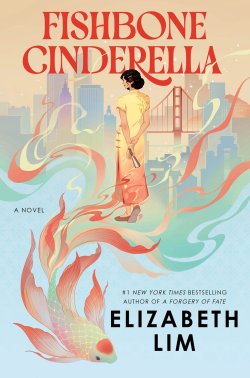
As a young girl in 1940s China, Yut Ying realizes she has the power to turn invisible. This power helps her survive the abusive household of her father and stepmother in Hong Kong, but 40 years later, she is at risk of disappearing altogether. Yut Ying’s daughter, Marigold, must uncover her mother’s past in order to save her, and from there, Lim unspools a generational tale of magic, endurance and love.
You’ve written numerous YA novels inspired by fairy tales, folklore and mythology. What are some of your favorite fairy tales or folktales that you’ve written about or would like to write about?
I have so many fairy tales and folktales that I love, so I’ll name two. I grew up loving the Wild Swans fairy tale, which is about a princess whose brothers are turned into swans and the only way to break their curse is by knitting nettle sweaters without speaking a word, and also the Chinese folktale The Cowherd and the Weaver, which is about two star-crossed lovers—a mortal and an immortal—who fall in love and must face heavenly consequences. Both of these tales provided inspiration for two of my novels, Six Crimson Cranes and Spin the Dawn.
“It’s very much a story rooted in reality rather than fairy tale.”
Speaking of fairy tales, this isn’t the first Cinderella-inspired novel in your portfolio—did Fishbone Cinderella provide any new discoveries or perspectives on this beloved story?
My other Cinderella-related book, So This Is Love, was a work published by Disney, and while I’ve always loved the 1950 film, I was eager to come back to the fairy tale with my own personal lens. Fishbone Cinderella’s inspiration draws from the Chinese version of Cinderella. In it, Cinderella has a magical guardian fish that she visits in a nearby pond. The fish is sent by her mother from heaven, and acts as the fairy godmother character that grants her the beautiful gown and golden slippers to wear to the spring festival. In addition, the Happily Ever After is a bit more ambiguous, which is something I wanted to explore in Fishbone Cinderella, as it’s very much a story rooted in reality rather than fairy tale. Moreover, it’s also rooted in history—particularly my family history. My grandmother lived with her stepmother in Hong Kong for many years, and the stories she told me about how she was mistreated always reminded me of Cinderella.
As Fishbone Cinderella is your adult debut, what excited you most about writing for an older audience?
I became a mother the year my first book was published (all the way back in 2018!), and as my children have gotten older, I’ve become particularly fond of mother-daughter stories. I wanted to write a book for adults to explore these relationships from different angles, and, in particular, I wanted to follow the life story of a woman from a young child to becoming a grandmother and follow the evolution of this character through her evolving life stages.
Yut Ying’s story predominantly takes place in 1940s China, while her daughter Marigold’s timeline begins in 1960s San Francisco. How did you arrive at the dual timeline structure of this novel, and how did you pick which decades to focus on?
Part of Fishbone Cinderella is inspired by my grandmother’s life story, namely her childhood in Hong Kong, then her early years in America. It was a very personal novel for me to write, and the time periods and settings were some of the easier choices to make since those very much relied on my family’s experiences. As for the dual-timeline structure, I initially wanted to cover three generations in depth, but I felt there was too much material to write into one book, so I decided to focus instead on a mother and daughter beginning from their childhoods, and have their timelines converge in their present.
Yut Ying, her mother and her daughter have all been cursed with special abilities in their lives. Does each person’s power hold special significance for the role they play in the family and one another’s lives?
This line of the book: “The first time I turned invisible, I was hiding in a cupboard . . .” was the first thing I wrote in my initial draft. Once in a while, I’m granted a gift while I’m writing, and this was one of them, meaning I always knew Yut Ying’s power would be invisibility. It just seemed to instinctively fit the character I wanted her to be and the story she was going to experience. I wanted to write a girl who initially comes into this power thinking it’s a gift, then slowly finds out it’s a curse, and it’s erasing her. Her mother and daughter’s powers, however, were harder to develop, but what was most important to me was that the three be connected and feel intentional, rather than something I forced to work.
“What’s important for me is that the reader has gone on a long journey with Yut Ying; there might be moments where you hate her, but you also understand her.”
One of the overarching themes of Fishbone Cinderella is the intergenerational trauma that spans these three generations. Could you expand on the importance of this theme to the story and character development?
Truthfully, I didn’t consider intergenerational trauma as a theme while writing Fishbone Cinderella. Intergenerational tension, maybe, but I’d say it was more in the back of my mind, and a byproduct of the story rather than something I mindfully considered as a theme. One of the reasons may be that I feel the term casts a modern gaze upon mother-daughter relationships that my characters while living their story wouldn’t be aware of at the time. My focus was always on the relationship between Yut Ying and Marigold, evolving over a span of 40 years. I wanted to show the burdens that one generation shoulders for another, why a mother might keep secrets from her daughter despite loving her unconditionally, and how the distance borne between two people who love each other might be overcome.
As you’re from San Francisco yourself, did your hometown and childhood influence the character development and setting of Fishbone Cinderella?
Yes, I loved writing the chapters set in California. I was born in Chinatown in San Francisco, and there was something special about bringing my characters to the places where I used to live, to explore the history of 1960s Chinatown and Berkeley and pay homage to the vibrant cultures there. Weaving delicious food into my novels is a theme across everything I’ve written, and I’ve never had the chance to wax poetic about Chinese American pastries, so I seized the opportunity here. It might have been a personal indulgence to make Marigold’s family own a bakery, but it worked out so well, and I hope those pages make my readers very hungry.
Read our starred review of ‘Fishbone Cinderella’ by Elizabeth Lim.
What was the research process like for the historical elements of this fantasy novel, and were there any real-life figures that served as muses?
My grandmother was a huge source of inspiration for Yut Ying, and I spent many hours recording her stories in person and asking questions over the phone. I grew up listening to her talk about her life in Hong Kong, eating the Cantonese food she’d cook for dinner—often dishes she said she loved from childhood, and this book became a way for me to honor her and immortalize those memories with her. Regarding the other historical elements, I did do research. I read books on Hong Kong, scoured photo archives and talked to family members and friends—but I think what was most enriching was getting to reconnect with my Cantonese upbringing, getting to include little nuggets of the things my grandmother and mother would say to me, like “Don’t go to sleep with your hair wet” or “Don’t eat too much fried food because it’ll give you yeet hay (an imbalance of heat in your body).”
How did you approach writing the story’s more difficult or unlikable characters in a way that feels three-dimensional?
When I was a younger writer, my mistake was trying to make my characters perfect. I think perfect characters are actually the most unlikable, because they’re simply not relatable. My characters in Fishbone Cinderella are far from perfect, but they also have their moments of unlikability. I love exploring the flaws that make us human, the mistakes we make that we end up regretting but have to live with anyway, and how we as people change as we age and enter different eras of our lives. For Yut Ying, you see her begin as a cheerful, gullible child and slowly become harder, more cynical. I think the situations that she encounters in her life, the people who betray her and mistreat her, are what shape her into the person that she becomes. What’s important for me is that the reader has gone on a long journey with Yut Ying; there might be moments where you hate her, but you also understand her. To me, that’s what makes her feel real.
“What helped was simply letting the magic exist. Not overthinking it.”
Would you say that this novel was inspired by magical realism stories, and if so, how?
I do love magical realism stories, but I can’t say that Fishbone Cinderella was inspired by any in particular. While writing this book, I did struggle with how to weave in the fairy-tale thread without making it feel forced or overdone. It took many tries and many times I wanted to quit, but what helped was simply letting the magic exist. Not overthinking it, and making sure that every time it was used, it was for a reason that would bring the character forward in her story.
Modern fairy tales often boast happy endings, even though the original stories often do not. How did you choose the ending of Fishbone Cinderella?
In many versions of the Chinese Cinderella, there’s not a Happily Ever After. Sometimes the king sells the golden slipper Cinderella wears to fund his army, other times he makes her his concubine or overuses the magic fish’s power so its bones disappear. Fishbone Cinderella is not a retelling; rather its story runs in parallel to the Chinese version of Cinderella, so I wouldn’t say that the ending is meant to resonate with the fairy tale. Rather, without spoilers, I chose an ending that offered some closure, some hope, but also some openness to what might happen to the characters in the future.
What is next for you and your writing journey? Can readers expect more folktale-inspired fantasies?
It’s too early for me to say yet whether my next projects will center around folklore or fantasy, but I think you can safely bet there will be some form of magic in whatever I write next!
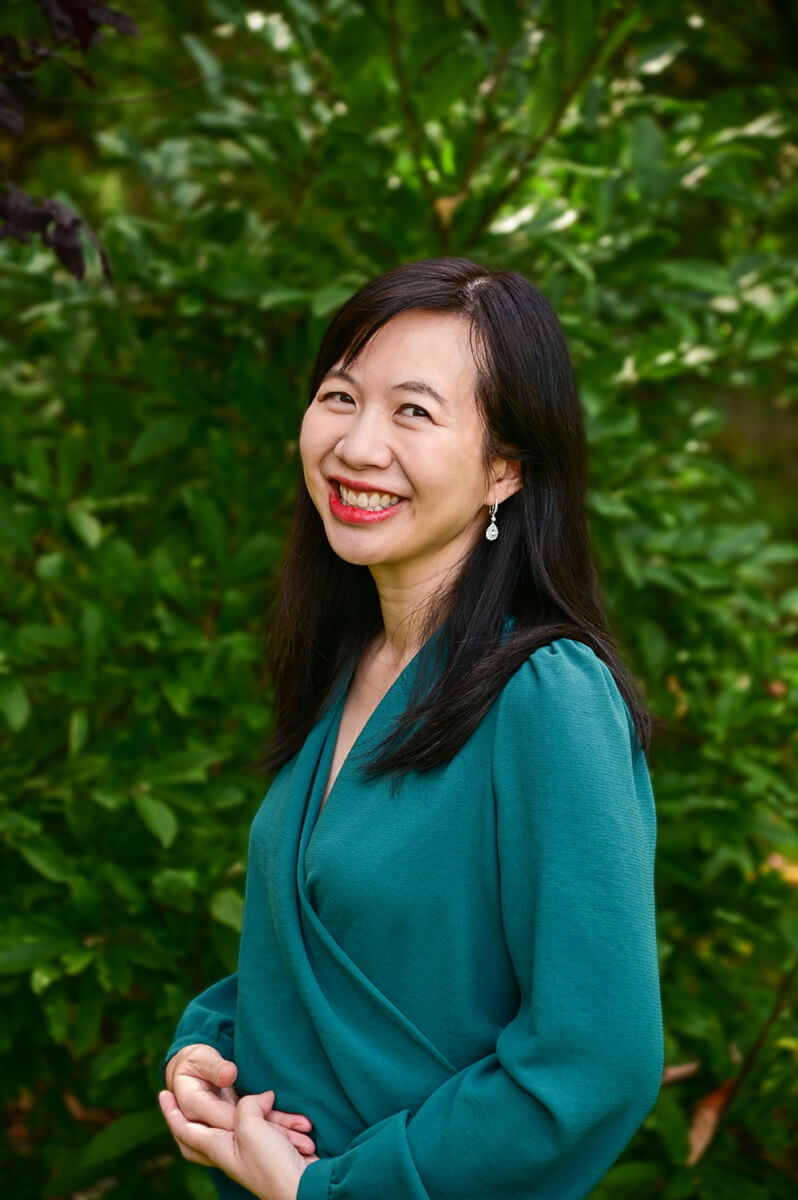
Photo of Elizabeth Lim by Adrian Ow.