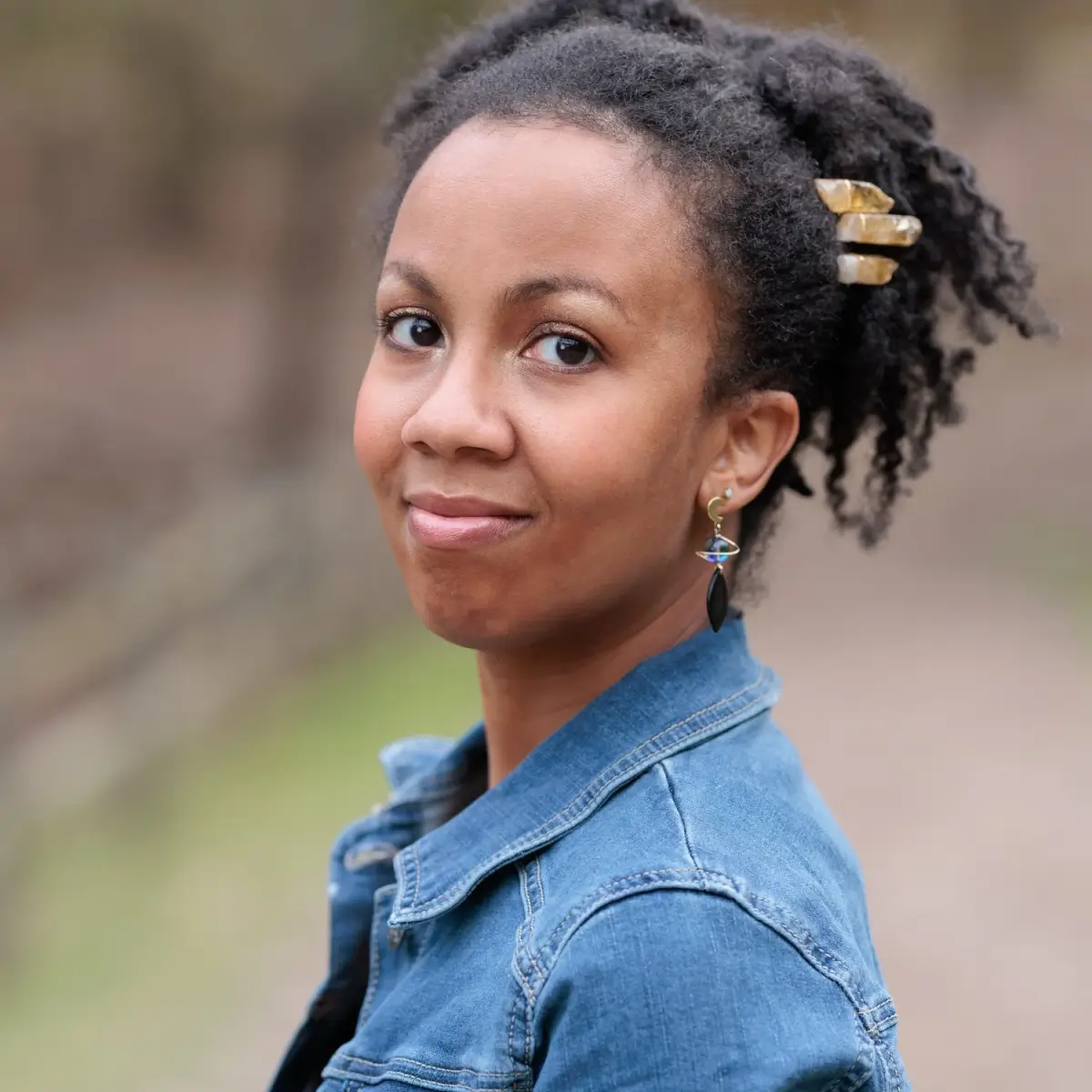
Shannon Sanders crafted her first novel, The Great Wherever—one of the most anticipated debuts of 2026—in the cracks between motherhood and a challenging day job.
On the surface, Sanders’ path to publication seems charmed. Her lauded short story collection, Company, was published by the elite indie Graywolf Press, and won the Los Angeles Times’ Art Seidenbaum Award for First Fiction. Then her novel manuscript received multiple escalating preempt offers, ultimately landing at Holt, within a big five publisher, and in the hands of an editor, Emily Griffin, who really seemed to get it. But that glittery summary masks an extended and taxing process of creation that would test anyone’s commitment.
Inspiration wasn’t the issue. The child of a sprawling and accomplished Black Southern family with a penchant for storytelling and a deep history, Sanders had been kindling the burning embers of The Great Wherever for years. As Sanders disclosed in a conversation with BookPage, a kernel of the story had been passed down through generations.
“My grandmother and her siblings are the co-owners of a century farm in Tennessee, a farm that’s been held by their family for over 100 years. . . . It’s a real source of pride.” Around the end of World War I in 1917, Sanders’ great-granduncle purchased a substantial plot of land. It was “pre-Civil Rights era,” decades before Jim Crow was dismantled, a time when there were significant barriers to Black landownership. Sanders’ great-granduncle navigated some of the same treacherous cultural terrain depicted in the 2025 movie Sinners, a story that also featured Black business and landowners facing resistance in the rural South (though Sanders’ family story is sans vampires).
“Women have always had to fight to protect their choices around motherhood.”
Sanders’ great-grandfather inherited the farm from his brother, and it has remained within the family ever since—against all odds and expectations, and despite a series of pointed challenges. Growing up, Sanders often thought about how difficult it must have been for her family to go from where they started to where they are now. Her great-grandparents were farmers and teachers. Together, they raised children who went on to live varied and productive lives, with most going to college. The family spread out across the country, even while holding on to and cherishing this property that still connected them.
Those facts alone are novel-worthy, but the story has more layers. Throughout her childhood, Sanders’ extended family converged on the Tennessee land every other year. At those gatherings, Sanders gleaned snippets of the past from the conversations of her elders and the stories they told, a kind of informal oral history. As she grew older, Sanders started to tune in more and more to the battles that her grandmother and grandmother’s siblings had confronted to hold on to that treasured property. It was no easy road. As she recalls, her family had dealt with a lot of what she terms “legal shenanigans”: challenges brought by some of their neighbors and the community around them who “tried to make [the land] harder for them to access and harder for them to make use of.”
And yet, while Sanders was fascinated by and proud of the experiences of her mother’s family, and felt they demanded unpacking, and as much as she wanted to honor her ancestors, she wanted to write fiction, not biography or history. Her family’s experience was an inspiration, but it couldn’t be the whole focus.
To that end, The Great Wherever is a work of great imagination, exploring modern life, history and inheritance with magic, humor and whimsy as well as poignance. At the center is Aubrey, a recently dumped and floundering woman who inherits her father’s share of a Tennessee farm haunted by generations of ghosts and secrets. Rather than an impersonal third person narrator, Sanders put those ghosts in charge of telling the story—and gave them attitude.
These dead aren’t noble spirits. They’re “relentless gossips,” judgmental and fallible just like the flesh and blood descendants they watch over (or snoop on), and it’s a genius touch. The specters have nothing to do but watch and reflect, so they are both messy and finely attuned to detail and nuance. Through their eyes, the novel is evocative, irreverent and smart about human existence and race. As one of Aubrey’s ghostly ancestors attests in the brilliant opening chapter, “The afterlife? It’s nothing like it looks in the movies.” For this she is thankful: “I died early on a Saturday morning wearing an old pair of H&M tights under an oversize Hot Chelle Rae T-shirt I had jury-rigged into a minidress. I was wearing the dress ironically—I wasn’t even a little bit into HCR; my tastes then ran moodier and boozier: Kendrick Lamar, Lana Del Rey—but if I were to get the Hollywood treatment, I’d be stuck in that minidress for all eternity.” In contrast with the celluloid version of eternity, in Sanders’ vision of life after death, the ancestors defy expectations. So, “although I died in an ugly way, I don’t look ugly. I look beautiful, more beautiful than I ever felt alive, though I was beautiful then, too.”
On the farm, that eternal beauty mostly “goes to waste,” visible only to spectral kin who are likewise in limbo: “A few relatives of mine from various generations who couldn’t care less. . . . Who, like me, got chopped from the family tree before their branches could flower. Who died on the receiving end of a particular unfulfilled promise.”
Those musings are typical of how the novel moves from humor to heartbreak and back. But even with the rich and multilayered backdrop as an anchor, when Sanders started writing, she initially felt stuck. She has a visceral memory of that time, recalling “I knew that there was some missing piece.” She was groping for something, some hook or drama to propel and give focus to the narrative.
Ironically, it was feeling like the world had tilted that got her unstuck. In 2022, the Supreme Court decided a life-changing, history-making case, Dobbs v. Jackson Women’s Health Organization, which overturned Roe v. Wade. Guaranteed federal access to abortion—already deeply eroded—dissolved altogether.
Looking back, Sanders vividly recalls a cascade of reactions and anger. “I could barely comprehend what I was reading,” she says. Even today, “it still feels like a bad dream.” As a millennial who came of age in the early 2000s, “within my circle of friends, we all took reproductive freedom for granted, and the culture around it was so foundational to the paths we took as young women.” That sense of security vanished in the blink of an eye. It was as though the terms of her existence as a woman had shifted: “Our educational, professional and dating choices were all inextricably tied to the assumption that we would be able to choose when and how to build our families.” By the time of the ruling, Sanders was married and a parent of three in her 30s. In her view, “the country I live in (and am raising children in) was making a policy-level push to reduce the freedom and empowerment I had taken for granted for my entire life.”
If there can be a bright side to such feelings of shock, for Sanders it was this: “My overwhelming response to the decision helped me unearth an element of the novel that I hadn’t explored yet.” She followed that thread, thinking about how “women have always had to fight to protect their choices around motherhood,” and found it incredibly compelling, and even exciting, to pursue. She reflected especially on “how those choices would intersect with other structural decisions, including those around land ownership, that shape a family’s lineage.” Ultimately, she realized, “that’s the other piece that I really want to explore: how these women’s decisions throughout this story in the book have also shaped the fate of this family.”
“The kids would go to bed, and then I would try to write anywhere from like 9 to 12 every night.”
Still, while those strong feelings had flipped a creative switch, Sanders faced practical hurdles that literally didn’t exist when she wrote her first book. As an aspiring author crafting the short stories that would become Company, Sanders had thrived on the support and camaraderie of writers workshops. From her home in Silver Spring, Maryland, she had access to the well-known Writer’s Center, nearby in Bethesda. That collective became her writing home.
But since then, her life had shifted enormously. With three small children at home, no matter how useful that kind of community scaffolding was, she no longer had the time to devote to its demands. For nearly a year after giving birth to twins in 2021, there was almost no writing whatsoever. This was truly unusual for Sanders, who had been a lifelong writer, beginning, like so many millennials, with “a lot, a lot” of X-Files fanfiction. In high school, Sanders was editor-in-chief of the literary magazine, and she took creative writing classes in college at Spelman even though her focus was on pre-law, and continued to write stories in her spare time after graduation. But as a mother with a demanding job, her writing practice had to take a backseat.
Then, when her baby boys were around 10 months old, they reached their own momentous milestone: They began sleeping through the night, just after Dobbs came out. In an act of almost superhuman discipline, Sanders started writing, producing the bulk of the novel while working around her 9 to 5 as an attorney and her kids’ sleep schedules, day care and other commitments. Her routine was that “the kids would go to bed, and then I would try to write anywhere from like 9 to 12 every night” while the rest of the house lay quiet.
It was hard work, but also freeing and creative. It helped that she has a strong support system both at work and at home. Writing taps into a different part of her brain than her painstaking legal work for a financial regulator, where she investigates acts of malfeasance like insider trading—though she says that, too, can be “kind of juicy” for someone who thrives on stories. It’s that love of storytelling that explains how a mother of infant twins could find the energy to write about hauntings on a Southern farm deep into the night after work and childcare.
Even now that the writing of The Great Wherever is finished, her discipline remains. Sanders approaches book promotion with a sense of determination and challenge, reserving evenings and vacation time for book events. She takes advantage of virtual events when possible, and for in-person events, it’s a family affair. The children look at kids books, or “listen to me talk for a few minutes, and then they can get bored and leave.”
Photo of Shannon Sanders by David Choy.