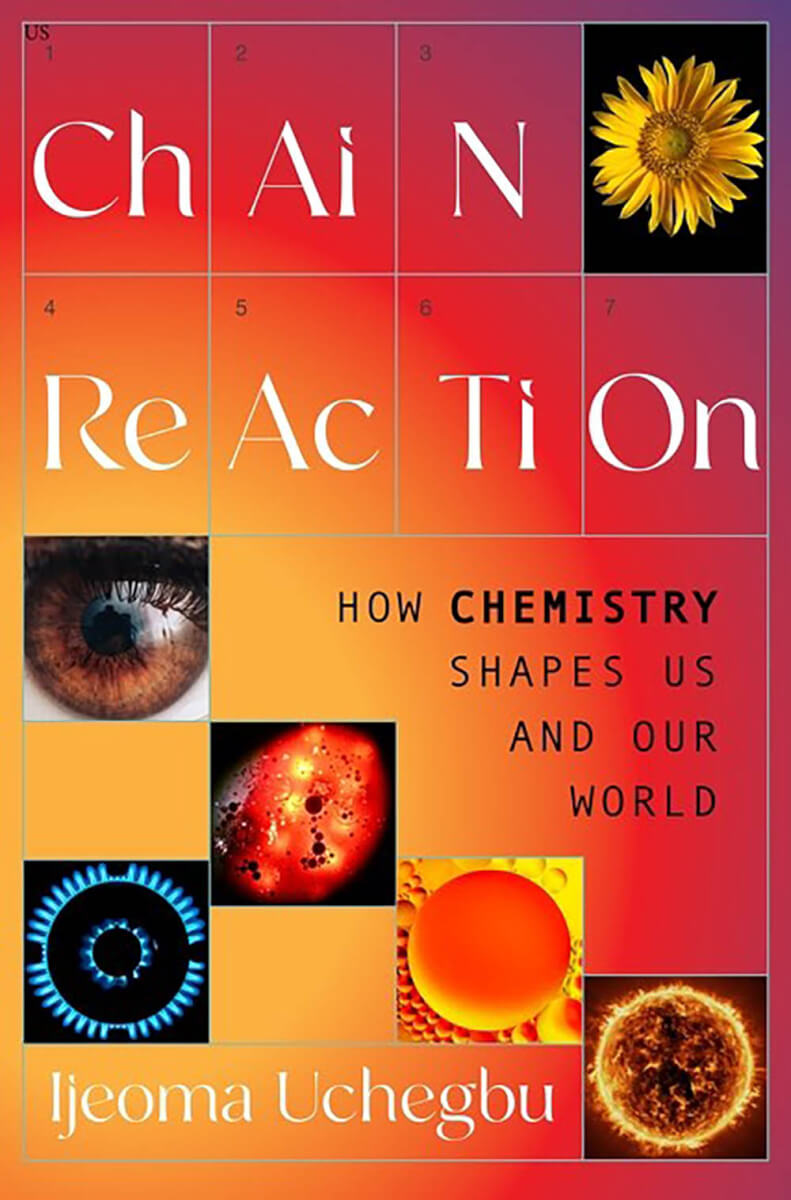
In her vivacious Chain Reaction: How Chemistry Shapes Us and Our World, research chemist Ijeoma Uchegbu celebrates the chemical bonds that dance—sometimes harmoniously, sometimes discordantly—among us and the world we live in.
From the moment we raise our heads from pillows filled with down or latex, walk across a ceramic floor or polyester carpet and maybe fry an egg or boil water for oatmeal, we interact with chemistry. Exploring the bonds between some of the 118 known elements—including aluminum, hydrogen, carbon, helium, oxygen and zirconium—Uchegbu illuminates the chemistry that underlies every process from the making of medicines and cosmetics to the construction of buildings and the ways we produce food. In a chapter devoted to “breaking down the stuff on our plates,” Uchegbu examines the complex interactions of carbohydrates, proteins, sugars and oils as they break down during the cooking process to produce smells and tastes that excite us, please us and, in effect, keep us alive. Satisfying our daily cravings serves a surprising number of functions. For example, most of us know that protein is broken down into amino acids essential to cell function; Uchegbu also reveals that amino acids “replenish compounds like dopamine, to make sure that pleasure still has a dominant place in our lives.” She also carefully considers the role chemicals play in food supply chains: Fertilizers, herbicides and pesticides are developed to raise crop yields to alleviate hunger, but the chemicals in them have also poisoned animals and humans. It’s the job of scientists to find a balance among safety, yield and sustainability.
Considering the human body, Uchegbu marvels that “we are all chemicals,” for every breath we take starts a chemical reaction in our cells and organs as they shuttle oxygen around, allowing us to take our next breath. Such chemical chains operate in good and ill health, as different sets of chemicals take over during the healing process. In her chapter on cosmetics, Uchegbu digs into the ways that “chemistry’s colours can change how we look and feel,” by explaining the emulsion structure of liquid foundation and how in the world waterproof mascara works. Uchegbu brings her own experiences as a layperson to the book, as when she describes chemically straightening her hair in her teens and 20s. This leads to a fascinating discussion of hair protein and melanin. Finally, Uchegbu looks at the chemistry of death and dying, revealing why bodily decomposition is a vital part of life on this planet.
Uchegbu’s style is so approachable and her enthusiasm so contagious that even the most chemistry-averse reader will find their ears pricked up. Chain Reaction reveals that we are chemistry and chemistry is us.