Last week I posted a simple question on the Real Men Real Style Facebook page: does a smartwatch belong with a suit? I figured I’d get fifty comments and a few jokes. I got over a hundred, and they were loud.
The split was fascinating. A strong majority shouted NO — one guy literally typed “NO” about a hundred times in a single comment, which made me laugh out loud.
But the minority defending the smartwatch with a suit included doctors monitoring real heart conditions, finance executives who live in airport lounges, and a few sharp-eyed gents who’d already cracked the strap-swap code. Their arguments were not dumb. Some of them were the smartest things in the thread.
So here we are, gentlemen. I’m going to walk you through what the community said, where the smartwatch earns its place on your wrist, where it absolutely does not, and how to wear one with tailoring if you’ve decided that’s your move. And yes, I’ll tell you where I land.
REAL MEN REAL STYLE
Do Smartwatches Belong With Suits?
Find out which wrist strategy fits your life and wardrobe
Built for the readers of Real Men Real Style.
Key Takeaways
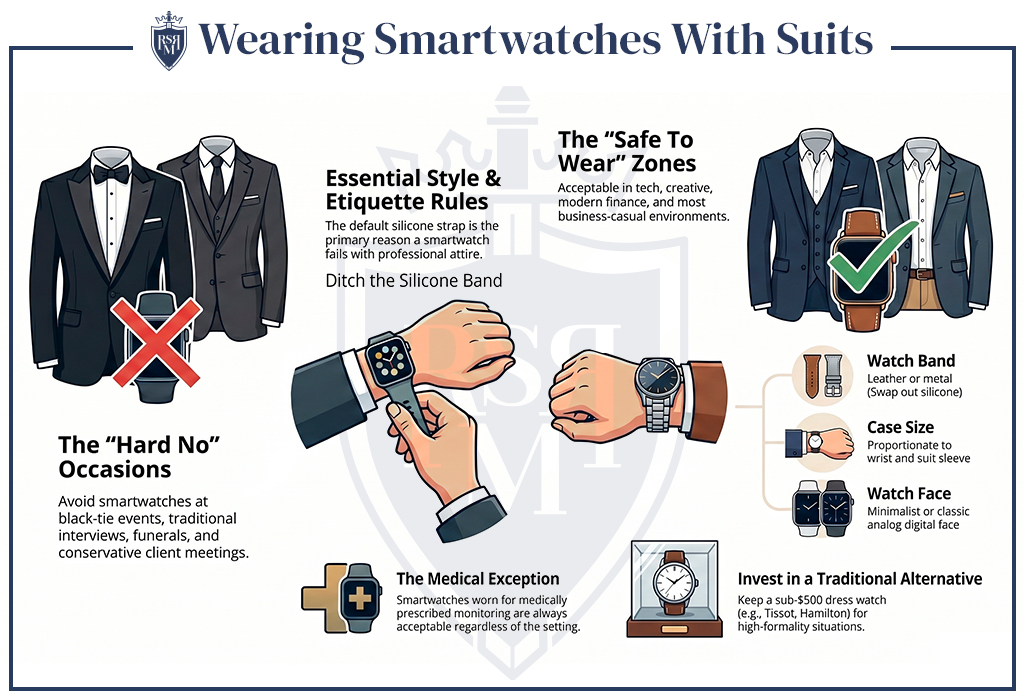
- The default silicone band is the single biggest reason a smartwatch looks wrong with a suit. Swap it before you do anything else.
- Medical use is not a loophole. If your cardiologist put it on your wrist, wear it without apology.
- Black tie, traditional industry interviews, funerals, and conservative client meetings — leave the smartwatch home.
- Tech, creative, modern finance, and most business-casual offices — a smartwatch with a suit is fine if the strap, face, and case size are right.
- A proper dress watch under $500 (Hamilton Khaki Field, Tissot Le Locle, Seiko Presage, Timex Marlin) belongs in every man’s drawer regardless.
The Short Answer
Yes — sometimes. A smartwatch with a suit can absolutely work, but only when you’ve handled the strap, the face, the case size, and your notifications like an adult. Most guys haven’t. Most guys throw a 45mm Apple Watch on the same orange silicone band they wear to spin class, then walk into a board meeting in a navy worsted two-piece and wonder why something looks off.
The other half of the answer is this: there are rooms where the smartwatch simply does not belong, and a grown man should know which rooms those are. A black-tie wedding. A funeral. A first interview at a 100-year-old law firm. You read the room. You dress the wrist accordingly.
Why This Became the Most Divisive Watch Question of the Decade
Think about the timeline. The Apple Watch launched in 2015. Ten years later there are well over a billion smartwatches on wrists worldwide. The suit, meanwhile, has been the uniform of professional men for roughly 150 years. The collision was inevitable.
I’ve been running RMRS for more than 15 years now, and I’ve watched this exact debate evolve in real time. In 2016 it was “smartwatches are a fad, ignore them.” By 2020 it was “fine for the gym, never with tailoring.” Today? Walk through any business-class lounge at O’Hare and count wrists. Every fifth one is a smartwatch, and half of those guys are in suits.

The community on Facebook is a great cross-section of where men actually stand. The traditionalists are still the majority, and I respect that. But the pro-smartwatch crowd has gotten smarter, and their arguments deserve a fair hearing.
The Case For — And My Honest Read
Let me walk you through the strongest pro-smartwatch arguments from the thread, and tell you what I think of each one.
Medical and Health Monitoring

This is the one that ends the debate for me. Several guys in the comments wear their Apple Watch or Garmin because their doctor told them to. Heart arrhythmia. AFib detection. Blood pressure trends. Post-surgical monitoring. One reader said the only time his watch comes off is to charge it or change the band.
If your cardiologist put a smartwatch on your wrist, you owe nobody — not me, not the watch snob at the next table, not the bride’s father — an explanation. Slap on a leather band, mute the notifications, and wear the thing. Your life is more important than the visual language of tailoring. End of conversation.
Modern Business Reality
A reader in finance pointed out that he sees Apple Watches on C-suite wrists at business dinners constantly now. Tech and creative industries crossed this bridge years ago. Even in traditionally conservative sectors, the top of the org chart is increasingly comfortable with a smartwatch under a suit cuff — because at that level, nobody is questioning your judgment over a watch choice.
The futurist minority in the comments had a line I keep turning over: “data is the new tie tack.” I don’t fully buy it. But I see the argument. The signal a man sends with his accessories has always shifted with the times, and right now, in a lot of rooms, a smartwatch reads as competent and modern, not lazy.
The Strap-Swap Aesthetic Argument

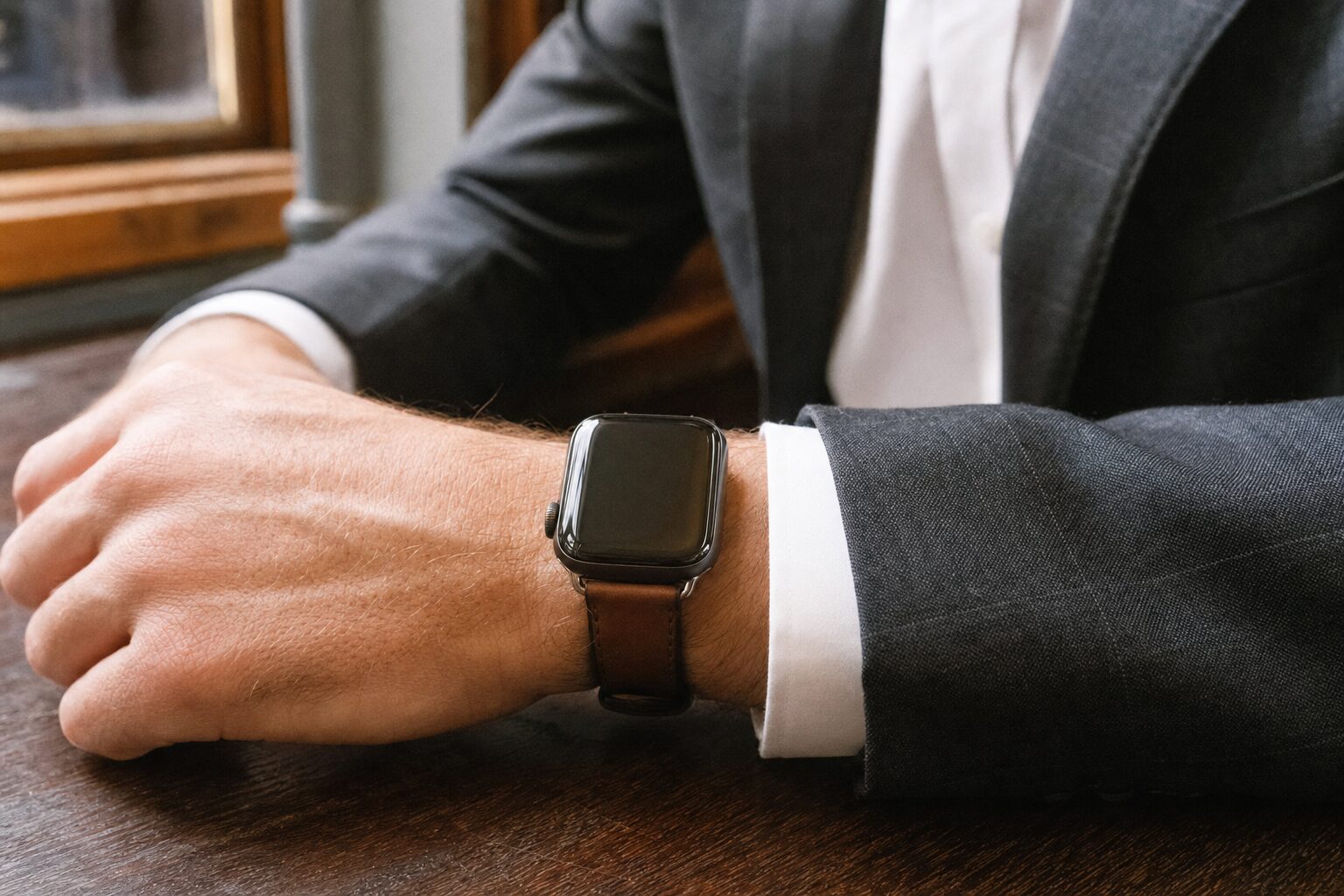
A few guys in the comments make this work consistently. Apple Watch on a Milanese loop in stainless. Or a quality brown leather band from Nomad. They report — and I believe them — that nobody at the meeting notices, comments, or cares. One reader put it like this: “It’s like your car — nobody cares but the driver.”
There was also a contrarian in the thread who said his slim round black Samsung looks better under a tailored cuff than the chunky silver dress watch he used to wear. On a slim wrist with a properly fitted shirt, he’s not wrong. A 41mm round face on a black leather band reads watch, not gadget.
Travel, Calendar, Quick Glances
Boarding passes, time zones, the calendar buzz that tells you the 3 p.m. is now 2:45. For the road warrior, a smartwatch is a genuinely useful tool. The Marines taught me a hard rule about gear — it earns its place by doing a job nobody else can do. For a lot of modern professionals, the smartwatch passes that test.
The Case Against — And My Honest Read
Now the other side. The hard-NO majority in the comments wasn’t wrong either. Here’s where they land their punches.
The Default Silicone Strap Problem

This is the single biggest visual offense, full stop. Silicone is built for sweat. It’s thick, it’s rubbery, it screams gym. Put it next to worsted wool, fine cotton, and polished leather and the whole outfit falls apart visually. Your eye is supposed to travel across complementary textures — wool, cotton, leather — and instead it snags on a chunk of black rubber.
Roughly 80% of the guys you see wearing a smartwatch with a suit have never changed the band. That’s the real problem. The smartwatch isn’t the villain. The default Apple silicone is.
You Can’t Coordinate Metals
The watch collector in the comments, the guy with 40+ pieces, made the cleanest version of the classic argument. He matches his watch case and buckle to his belt, his shoes, and his cufflinks for every outfit. Silver with silver. Gold with gold. Brown leather with brown leather.
A smartwatch fights that game. The case is usually aluminum or a dark coating that doesn’t read as a metal in the traditional sense. You can get closer with a steel Apple Watch and a Milanese loop, but you can’t truly match it the way a Hamilton or an Oris coordinates with the rest of your kit. Read: How to match accessories in men’s wardrobe.

The Signal You Send in a Formal Room
Walk into a funeral with notifications buzzing on your wrist and you’re telling the room that an email matters more than the person in the casket. That’s not a style problem. That’s a character problem. The same logic applies, in a softer form, to weddings, formal dinners, and any moment where the people around you deserve your full attention.
A traditional dress watch sends one signal: I keep time, I respect this occasion, and my attention belongs to you. A smartwatch sends a more complicated signal. In the wrong room, that complication reads as rude.
Disposability
Your grandfather’s Hamilton from 1962 still runs and your son will inherit it. Your Apple Watch Series 8 is e-waste by 2027. There’s nothing wrong with that — it’s a tool, tools wear out — but it tells you something about what a smartwatch is and isn’t. It’s an appliance, not an heirloom.
Notifications Mid-Handshake
A wrist that lights up while you’re shaking a client’s hand is worse than no watch at all. The traditionalist in the comments was blunt: humanity managed for centuries without smartwatches at the dinner table. He’s right. If you can’t keep the thing on Do Not Disturb in a meeting, you don’t have the discipline to wear one with a suit.
The Situation Matrix — When To Wear, When To Skip
Here’s where I land, situation by situation. Print this and tape it inside your closet door if you want.
| Situation | Smartwatch With a Suit? |
|---|---|
| Black tie / formal weddings / funerals | NoDress watch or bare wrist. |
| Job interview — traditional industry (law, finance, government) | NoBorrow a dress watch if you have to. |
| Job interview — tech or creative | FineWith the right strap and face. |
| Standard business / office | FineStrap-swapped, notifications muted. |
| Business travel | FineThis is where it earns its keep. |
| Client lunch — finance or law | Trending NoWhen in doubt, dress watch. |
| Client lunch — tech or creative | Fine |
| Medical necessity, any context | Wear itNo apology required. |
| Smart casual / sport coat | Fine |
| Gym, run, ride | Obviously |
The matrix isn’t gospel. It’s a starting point. The actual rule is simpler: read the room, read the dress code, and ask yourself who you’re trying to respect with your wrist choice.
If You’re Going to Wear One With a Suit, Do It Right
Alright. You’ve decided the smartwatch is staying on your wrist for the boardroom and the business dinner. Here’s how you make it work.

1. Swap the Strap. Always.
This is the single most important move you’ll make. The default silicone has to go. Replacements that work with a suit:
- Brown leather band — Nomad and Bullstrap make excellent options under $80. Pair with brown belt and shoes.
- Black leather band — same idea, paired with a black belt and black oxfords or cap-toes.
- Stainless Milanese loop — the Apple OEM is fine; aftermarket options run $20–$40.
- Stainless link bracelet — most formal smartwatch option available. Pairs with steel cufflinks.
Skip the nylon NATO straps for business. Those are weekend territory.
2. Match the Metals
Silver case, silver buckle, silver cufflinks, silver tie bar. If you’re in a gold watch case (less common in smartwatches but it exists), gold buckle and gold accessories. Mixed metals look like you got dressed in the dark.
3. Change the Watch Face
Apple, Garmin, Samsung — they all let you change the face. During business hours, run a classic analog face. Black or white background. Roman or Arabic numerals. Simple hands. Hide the rainbow activity rings and the step counter. You’re trying to look like a man with a watch, not a man with a smartphone strapped to his arm.

4. Mind the Case Size
A 45mm or 49mm slab on a 6.5-inch wrist looks ridiculous, especially under a tailored cuff. The Apple Watch comes in 41mm and 45mm sizes now. Most men should go smaller. Same rule applies to dress watches — 38-40mm is the sweet spot for most wrists. Read: Men’s Dress Shirt Cuffs
5. Do Not Disturb. Non-Negotiable.
Before you walk into a meeting, a dinner, a client lunch — Do Not Disturb on. No haptics, no screen lighting up, no calendar buzz. If your watch lights up during a handshake, you’ve lost the room. This isn’t optional.
6. Tuck It Under the Cuff

A properly fitted shirt cuff covers your watch except when you actively extend your arm. (The exception is the late Gianni Agnelli, who famously wore his watch over the cuff — but he was Gianni Agnelli, and you are not.) Your shirt sleeve should sit at the base of your thumb when your arm hangs at your side, with about a quarter inch showing past the suit jacket cuff.
The Medical Exception — Said Plainly
If you wear a smartwatch because of a real medical reason — AFib, blood pressure monitoring, post-cardiac event, sleep apnea tracking, whatever your doctor prescribed — wear it everywhere, including the wedding, the funeral, and the board meeting.
Put it on a leather or stainless band. Mute the notifications. Set a classic face. And then stop thinking about it. Anyone who side-eyes a man for monitoring his own heart needs a longer think about their own priorities.
I have a 40% disability rating from my time in the Marines. I take that seriously. Your health takes precedence over every style rule I or anyone else has ever written.
What About a Smart Ring Instead?

One sharp reader in the Facebook thread raised this and it deserves a mention. If you want the health data — sleep, heart rate, recovery, activity — without the wrist real estate, a smart ring like the Oura or the Ultrahuman Ring gets you most of the way there.
You wear a proper dress watch on the wrist, you wear the ring on a finger (most guys go index or middle), and nobody at the meeting knows you’re tracking a thing. It’s not for everyone — you lose the calendar buzz, the texts, the boarding pass on your wrist — but for the guy who specifically wants the health data, it’s a clean compromise.
The Best of Both Worlds — Hybrid Smartwatches
Worth flagging for the man who really wants both: the Withings ScanWatch is the most suit-friendly smartwatch on the market. It’s a genuine analog watch with real hands and a classic face, with smart functions hidden underneath — heart rate, ECG, sleep tracking, notifications via a tiny sub-dial.
At a glance, it reads as a real watch. Because it is. The Garmin Vivomove line plays a similar game. If you want the data without the screen, look at these before you commit to an Apple Watch.

If You Skip the Smartwatch — Wear One of These Instead
Every man should own at least one proper dress watch. Here’s where I’d start, in order of price.
Under $300:
- Timex Marlin Hand-Wound — $200ish, slim 34mm or 40mm case, classic mid-century styling. Punches way above its weight.
- Seiko Presage Cocktail Time — around $400 but often on sale. Stunning dial, dress-watch proportions.
Under $500:
- Hamilton Khaki Field Mechanical — the classic. 38mm or 42mm, military heritage, runs forever. I’ve recommended this watch on RMRS for a decade and I’ll recommend it for another decade.
- Tissot Le Locle Automatic — Swiss-made, sub-$500 frequently, dressier than the Hamilton.
Step up ($800–$2,500):
- Longines Master Collection or Conquest — proper Swiss heritage, dress-watch elegance.
- Oris Big Crown Pointer Date — distinctive, well-made, holds value.
Statement piece ($3,000+):
- Tag Heuer Carrera — if you want something with presence and history.
Also read: Old Money Watches
Common Mistakes to Avoid
Quick hit list. Most of these I’ve seen on actual clients walking into actual offices.
- Default silicone band with worsted wool. Number one offense. Fix it tonight.
- Notifications on in a meeting. Number two offense. No excuse.
- 45mm case on a 6.5-inch wrist. Looks like you’re wearing your dad’s TV remote.
- Mixed metals. Silver watch, gold belt buckle, silver cufflinks. Pick a lane.
- Watch over the cuff. Unless you’re an Italian industrialist, tuck it under.
- Rainbow activity-ring face during business hours. Run a classic analog face.
- Letting the watch dictate the outfit. The watch supports the suit, not the other way around.
Bottom Line — Where I Actually Land
After reading all 100-plus comments, after fifteen years of fitting men, after watching this debate evolve from “smartwatches are a fad” to “smartwatches are on a billion wrists” — here’s my honest read.
The smartwatch with a suit isn’t a sin and it isn’t a virtue. It’s a tool. Right context, right strap, right discipline with notifications, and it earns its place on your wrist. Wrong context, wrong strap, wrong moment — and you look like you forgot to change after the gym.
The hard-NO majority in our community isn’t wrong, exactly. They’re defending something worth defending — the idea that a man’s accessories should be intentional, coordinated, and respectful of the occasion. I’m on their side more often than not. For black tie, for funerals, for a first interview at a serious firm, for the wedding where you’re the father of the bride — a proper dress watch wins, and it isn’t close.
But for the doctor monitoring his own heart, for the traveler living between time zones, for the executive whose calendar runs his day, for the tech-sector creative who’d look like he’s in costume wearing a Submariner — the smartwatch on a brown leather band, with the notifications muted and the face set to classic analog, is a perfectly grown-up choice.
Read the room. Dress the wrist accordingly. That’s the whole game.

FAQ
Can you wear an Apple Watch with a suit? Yes — with a strap swap to leather or stainless, a classic analog watch face, Do Not Disturb on, and a size-appropriate case (41mm is better than 45mm for most wrists). For black tie, funerals, or traditional-industry interviews, leave it home.
Is a smartwatch okay for formal events? For black tie, formal weddings, and funerals, no. A proper dress watch — or even a bare wrist — is the right call. The exception is medical necessity, in which case you wear it without apology, on a leather band, notifications muted.
Smartwatch vs dress watch — which is better for business attire? A dress watch is the safer, more traditional choice and works in 100% of business contexts. A smartwatch works in roughly 70% — fine in tech, creative, modern finance, and most office environments, but skip it for conservative industries and high-stakes first impressions.
What’s the best smartwatch to wear with a suit? The Withings ScanWatch is the most suit-friendly because it looks like a real analog watch. If you’re staying with an Apple Watch, go with the stainless steel case in 41mm on a leather or Milanese band, not aluminum on silicone.
Does anyone actually care what watch I’m wearing? Honestly? At most meetings, no. But the people who do notice tend to be the people whose opinion matters most — senior partners, established clients, your future father-in-law. The point of dressing well isn’t to impress everyone. It’s to never be the reason you didn’t get the deal, the job, or the respect.
That’s my take. Now I want to hear yours — drop a comment on the RMRS Facebook page or RMRS YouTube channel. The debate is far from over, and the smartest stuff I read all year was in that original thread.