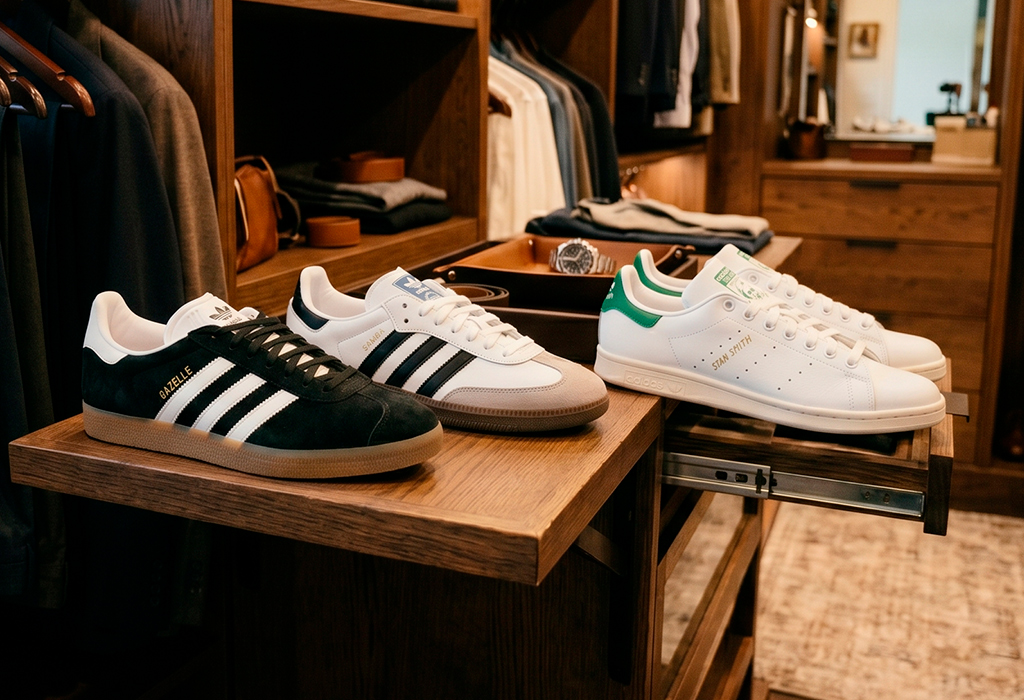
A buddy of mine texted me a photo last spring. Black Sambas, off-white socks, slim selvedge jeans, an unstructured navy blazer thrown over a plain white tee. He wanted to know if the shoe was too trendy to pull the trigger on. My answer was short: the Samba has been around since 1950. Nothing that survives seventy-five years is a trend.
Here’s what I’ve watched happen over the last two decades of doing this work. A guy figures out his suit situation. He locks in his shirt game. He finally buys a pair of real leather oxfords. And then he stalls out — because dressing well on the weekend, in jeans and a tee, at the park with his kids, grabbing a beer with friends — that’s harder than it looks. The shoe he’s wearing usually gives him away.
Adidas solves a big chunk of that problem. Three stripes, clean silhouettes, decades of heritage, and pricing that sits well under what you’d pay for a pair of Italian sneakers that ultimately do the same job. Gents, if you want one casual shoe that works across every situation short of a funeral, you’re probably about to buy something with a trefoil on the tongue.
The trouble is, Adidas doesn’t make one iconic sneaker. They make about six. And the differences between them are bigger than most men realize.
Why Adidas earned its spot in the men’s style canon
A short history lesson, because it matters.
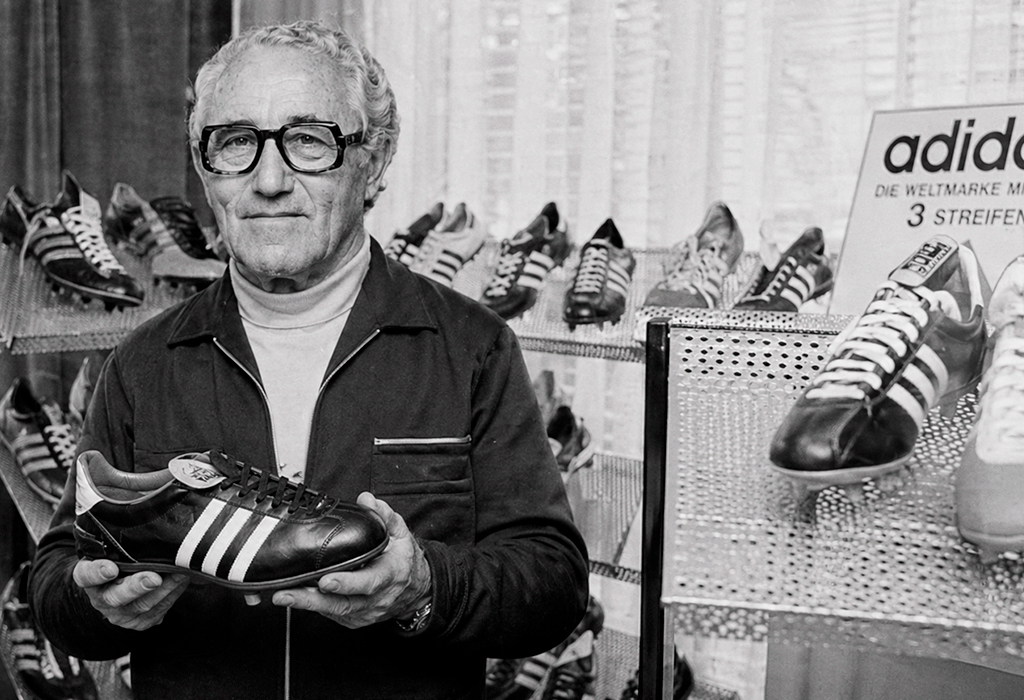
Adi Dassler started making athletic shoes in Germany in the 1920s. The three stripes were originally a structural reinforcement — they kept the leather upper from stretching out during a match. Form followed function. Somewhere along the way, the stripes became the single most recognizable sports mark in the world, and Adidas went from making boots for footballers to making shoes for everyone from Run-DMC to tennis pros to the kid behind the counter at your local coffee shop.
What you’re buying when you pick up a pair of Adidas Originals isn’t just a shoe. You’re buying into a visual language that’s been developing for seventy-plus years — soccer pitches, tennis courts, basketball arenas, British terraces, hip-hop videos, art school hallways. It’s a deep catalog, and any man with a casual wardrobe should know how to read at least six pieces of it.
Let me walk you through the lineup.
1. The Adidas Samba — the iconic indoor trainer
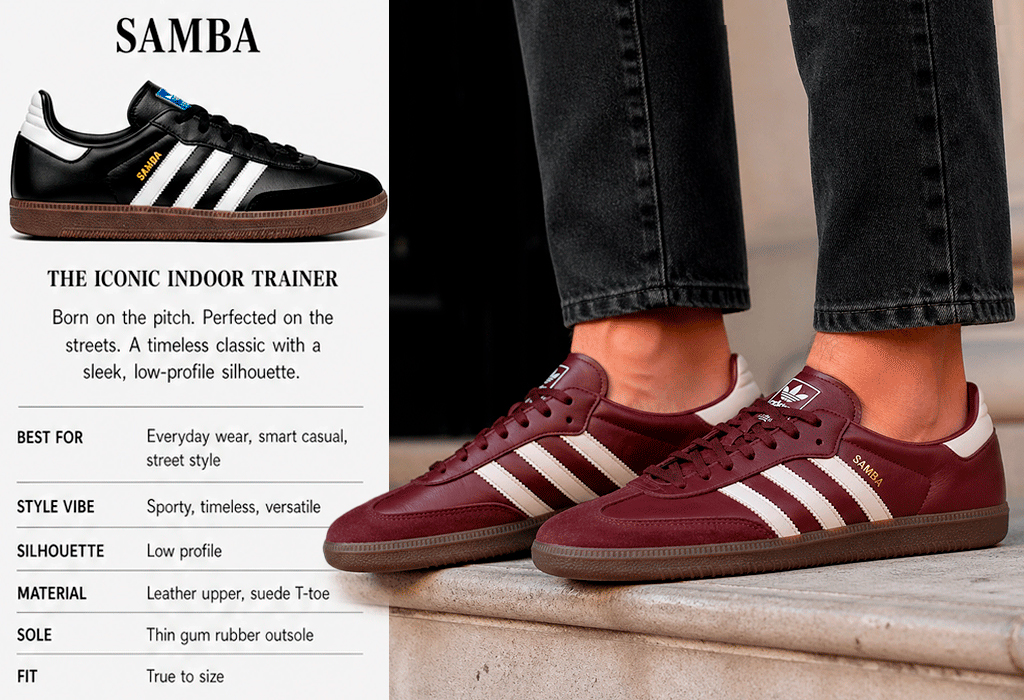
Born on the pitch. Perfected on the streets. The Samba started life in 1950 as a football training shoe, built for guys who needed grip on hard-packed surfaces when the fields froze over. Black leather upper, white three stripes, gum rubber sole, suede T-toe for durability where your foot strikes the ball.
Here’s why it’s everywhere right now: the profile is low. Lower than a Stan Smith, lower than almost any other leather sneaker at the price point. That low profile makes it sit clean under a slim trouser or a tapered jean, without that chunky dad-shoe silhouette that makes older guys look like they gave up. Pair it with a raw selvedge denim, a crewneck tee, and a fatigue jacket, and you’ve got a Saturday uniform that works at age 28 and age 48.
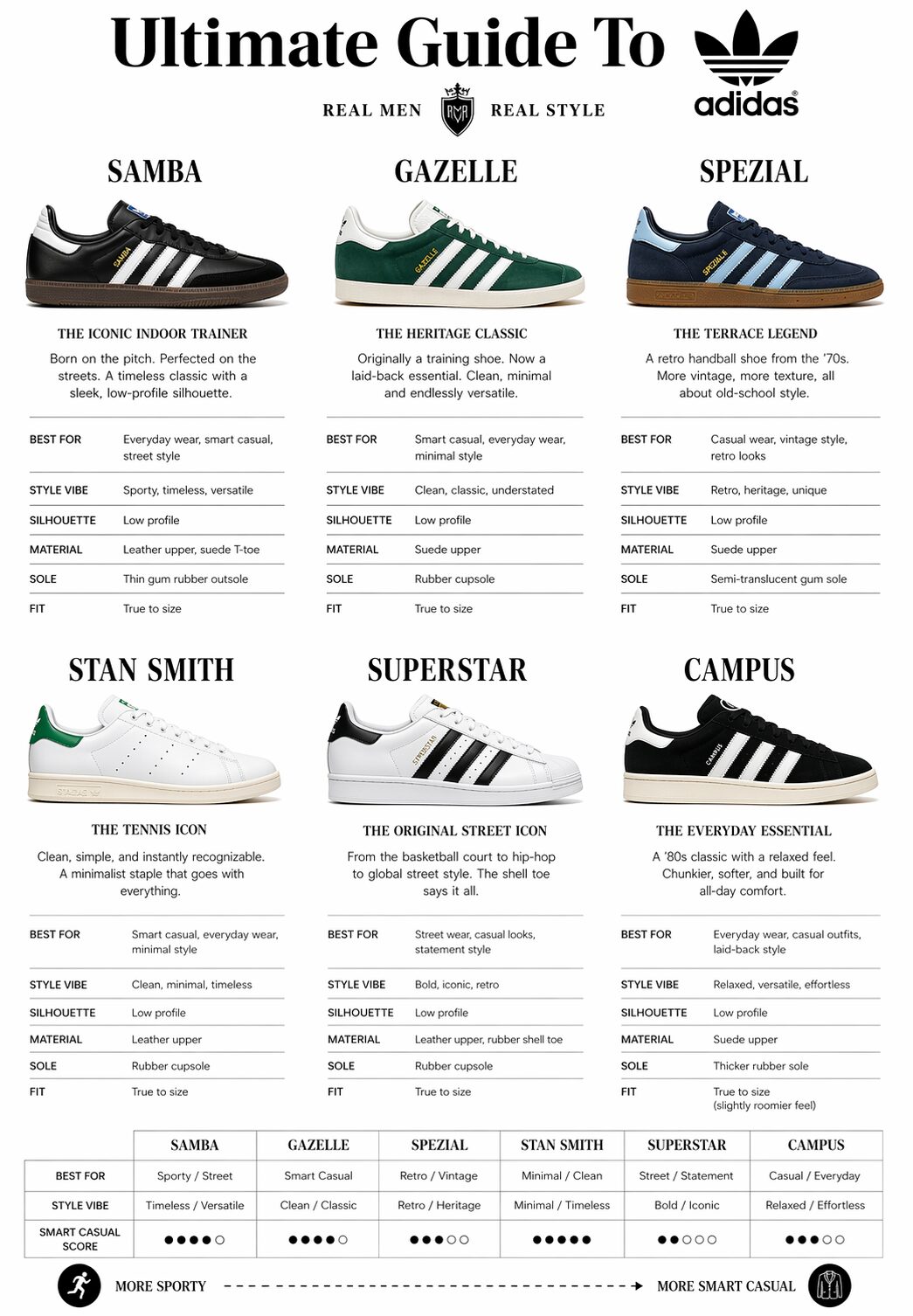
Best for: everyday wear, smart casual, street style. Style vibe: sporty, timeless, versatile. Material: leather upper, suede T-toe. Sole: thin gum rubber outsole. Fit: true to size.
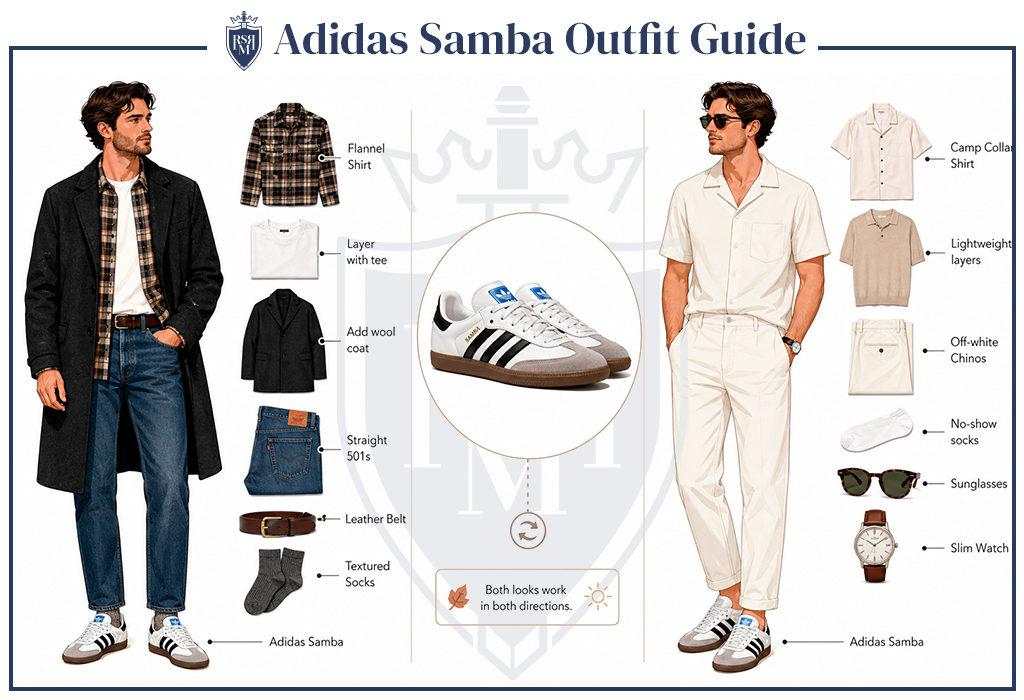
I wear mine with straight 501s and a flannel in the fall, and with off-white chinos and a short-sleeve camp collar shirt in the summer. Works in both directions.
One note — the Samba runs narrow. If you have a wide foot, try them on before you commit, or size up a half. Some guys do, some don’t. I run true to size but my wife can’t wear them at all. Feet are feet.
2. The Adidas Gazelle — the heritage classic

Originally a training shoe. Now a laid-back essential. The Gazelle came out in 1966 as an all-purpose trainer — suede upper, contrasting three stripes, slim rubber cupsole. What separates it from the Samba is the material and the silhouette. Suede instead of leather gives it a softer, more casual feel. Slightly slimmer, slightly more elegant.
I own a pair in forest green with the cream sole. They work with raw denim, olive chinos, grey wool trousers (yes, really), and when I’m traveling and don’t want to pack two pairs of shoes, these come with me because they’ll do duty with everything short of a jacket and tie.
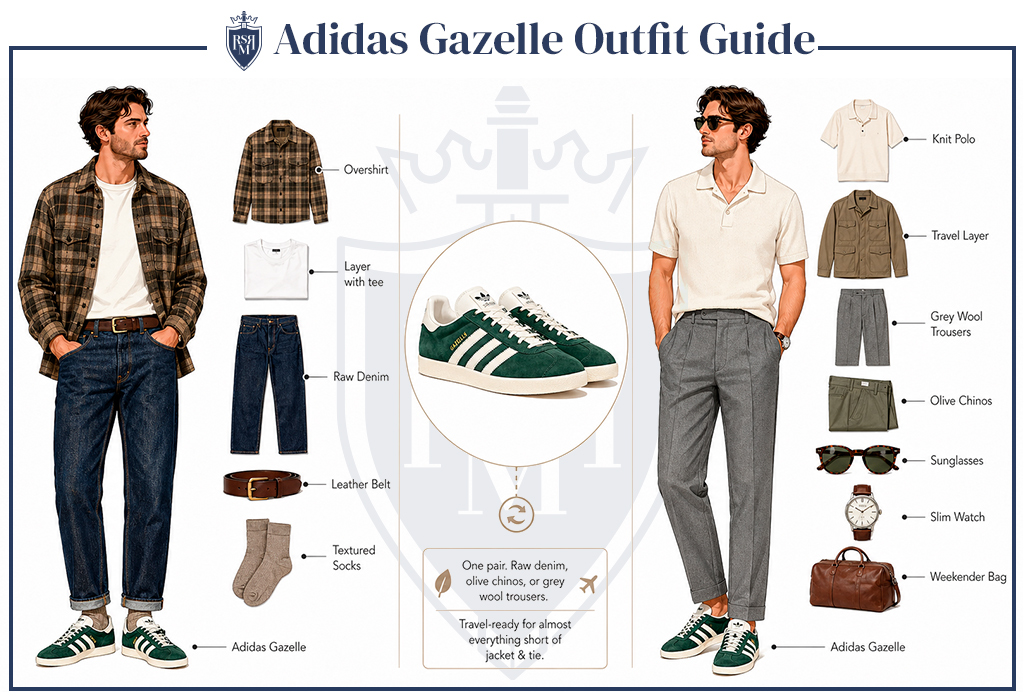
Best for: smart casual, everyday wear, minimal style. Style vibe: clean, classic, understated. Material: suede upper. Sole: rubber cupsole. Fit: true to size.
The play here is color. A Samba is almost always black or white. A Gazelle lives in the color palette — forest green, navy, burgundy, dusty blue, mustard. Pick a color that slots into your existing wardrobe, not the brightest one on the shelf. I’d say start with navy or green. Those two colors are the workhorses, and they don’t look dated five years from now.
If you’re already figuring out how to build a small, capable wardrobe, this is a shoe that earns its place. I wrote a longer piece on building a minimalist men’s wardrobe if you want the whole framework.
3. The Adidas Spezial — the terrace legend

A retro handball shoe from the ’70s. More vintage, more texture, all about old-school style. If the Samba is the working-class hero and the Gazelle is the quiet intellectual, the Spezial is the cool older cousin who spent a year in Manchester and came back with opinions about music.
The Spezial (short for “Spezialschuh,” German for “special shoe”) was born as indoor handball footwear. The British adopted it in the ’80s terrace subculture — working-class lads at football matches, trainers as tribal identity. The shoe has that history baked into it, and you can feel it. The suede is thicker and more structured than a Gazelle. The silhouette has a little more character. The gum sole is usually semi-translucent. You’ll most often see it in navy with light blue three stripes, which is the classic Manchester-era colorway.
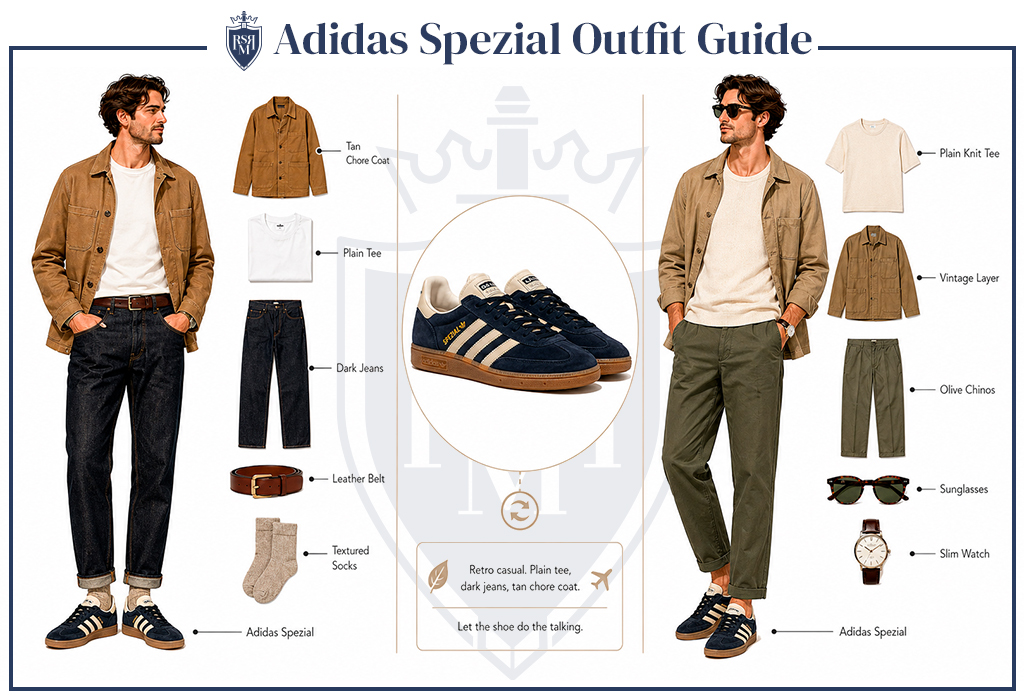
Best for: casual wear, vintage style, retro looks. Style vibe: retro, heritage, unique. Material: suede upper. Sole: semi-translucent gum sole. Fit: true to size.
Fair warning — this is the one shoe on this list that takes a little more style confidence to pull off. The navy and pale blue colorway is loud compared to a Stan Smith. Wear it with quieter clothes. Plain tee, dark jeans, maybe a tan chore coat. Let the shoe do the talking.
4. The Adidas Stan Smith — the tennis icon

Clean, simple, and instantly recognizable. A minimalist staple that goes with everything. The Stan Smith started as a tennis shoe in the 1960s, originally known as the Adidas Robert Haillet after a French tennis pro, and was rebranded in 1971 after Stan Smith — an American player — won Wimbledon wearing them. All-white leather upper, perforated three stripes (because Adidas wasn’t allowed to put their full branding on a tennis shoe at the time, due to tennis regulations), green heel tab.
This is the cleanest white sneaker on this list. Flat white leather. No texture. No contrast sole. No visible branding beyond the heel tab and the tongue. The whole design is about disappearing on your foot and letting the rest of the outfit breathe.

Best for: smart casual, everyday wear, minimal style. Style vibe: clean, minimal, timeless. Material: leather upper. Sole: rubber cupsole. Fit: true to size.
Here’s the mechanism: a white leather sneaker reads as dressier than a colored suede one, because the all-white palette mirrors how a dress shoe works — it’s monochrome, low-contrast, disciplined. You can wear a Stan Smith with tailored wool trousers and an oxford shirt to a casual office, and nobody’s going to clock it as sportswear. Try that with a Spezial and you’ll look like you got lost on your way to a match.
If you’re building your first casual shoe rotation and you only have the budget for one sneaker, I’d argue the Stan Smith is the safest bet. It does more jobs than any other shoe on this list. Watch your feet on one, though — white leather shows scuffs fast, and a dirty white sneaker looks worse than no sneaker at all. Hit them with a damp microfiber once a week and they’ll keep looking sharp.
5. The Adidas Superstar — the original street icon

From the basketball court to hip-hop to global street style. The shell toe says it all. The Superstar dropped in 1969 as a low-top basketball shoe — revolutionary at the time, because basketball shoes were almost all high-tops. The reinforced rubber shell toe protected the leather upper from wear, and it turned into one of the most recognizable design details in sneaker history.
Then came Run-DMC. The group wore Superstars — no laces, fat tongue pushed forward — as part of their stage uniform, and in 1986 they released the track “My Adidas,” which led to Adidas signing the first non-athlete endorsement deal in sneaker history. The shoe went from sports gear to cultural shorthand overnight.

Best for: street wear, casual looks, statement style. Style vibe: bold, iconic, retro. Material: leather upper, rubber shell toe. Sole: rubber cupsole. Fit: true to size.
This is not a quiet shoe. The black three stripes on a white leather upper plus the bold shell toe makes a statement. If your personal style runs minimal — if you mostly wear gray, navy, olive, and you like your clothes to let you disappear into the crowd — the Superstar is probably not your first pick. If you lean a little louder, if you grew up listening to hip-hop, if you like a clothing piece that has a visible point of view, this is your shoe.
Wear it with straight-leg jeans (not slim — slim jeans and a bold shell toe fight each other), a plain tee, and maybe a varsity-cut jacket. Don’t try to dress it up. The Superstar doesn’t want to go to work with you.
6. The Adidas Campus — the everyday essential

An ’80s classic with a relaxed feel. Chunkier, softer, and built for all-day comfort. The Campus evolved from the older Tournament basketball shoe, simplified and resoled for everyday wear. Suede upper, contrasting three stripes, thicker rubber sole, relaxed fit.
Here’s what makes the Campus different from the Gazelle, since they look similar at first glance. The Campus has more volume — the upper is slightly rounder, the sole is thicker, the whole shoe has a little more presence on your foot. It’s less elegant than a Gazelle. But it’s more comfortable for long days, and it has a slouchier, more ’80s look that works really well with wider-leg trousers and baggier jeans — which is exactly the direction a lot of men are moving in as skinny-cut everything finally dies off.
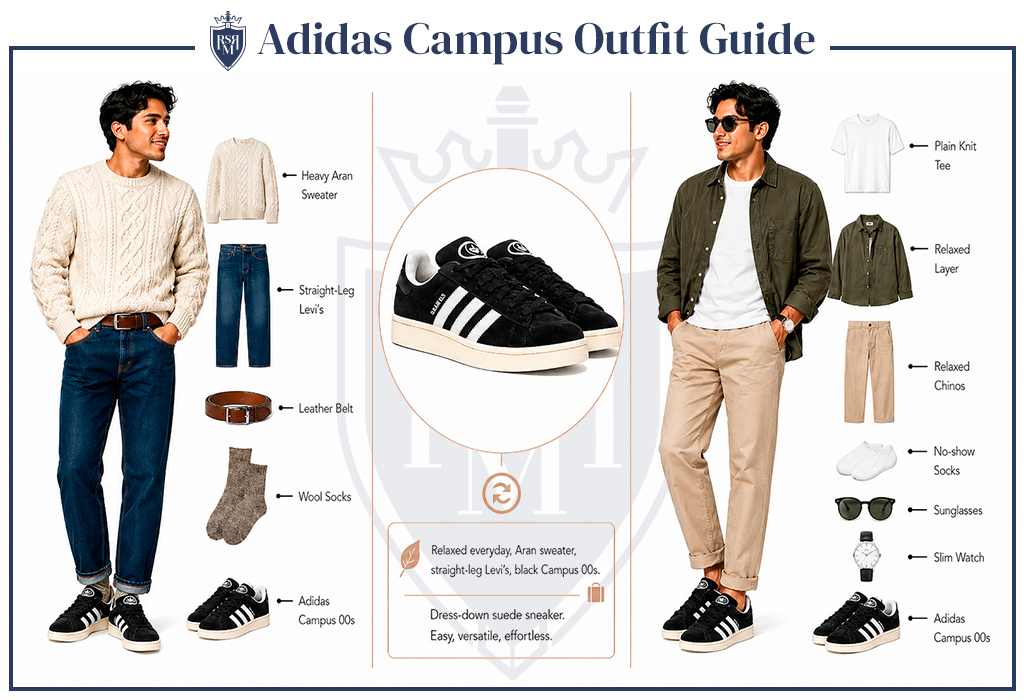
Best for: everyday wear, casual outfits, laid-back style. Style vibe: relaxed, versatile, effortless. Material: suede upper. Sole: thicker rubber sole. Fit: true to size (slightly roomier feel).
I bought a pair of black Campus 00s a couple of winters ago to wear with straight-leg Levi’s and a heavy Aran sweater, and honestly, they’ve become the shoe I grab when I don’t want to think about an outfit. Easy, comfortable, pull-on, pull-off. If the Gazelle is the dress-up version of a suede sneaker, the Campus is the dress-down version. Both are good. They answer different questions.
So which one should you actually buy?

Fair question. Six shoes is a lot, and nobody buying their first pair needs all of them. Here’s how I’d rank them for the average guy reading this, based on what job you need the shoe to do.
- If you want the most versatile smart-casual sneaker on the list — the one shoe that works with chinos to a nice restaurant, with jeans to a Sunday lunch, with grey wool trousers to a casual office — buy the Stan Smith. All-white leather reads cleaner and dressier than anything else here. It’s the one most likely to get you into places where sneakers are technically frowned upon but tolerated if they look sharp.
- If you want the shoe you’ll wear with jeans four times a week, and you want it to age into something with character — buy the Samba. The low profile is flattering under every cut of trouser. The black-and-white colorway is neutral enough to work with anything. The gum sole adds just enough warmth to keep it from looking clinical. This is probably the most versatile casual sneaker made today, at any price.
- If you already own one white sneaker and you want to add color and texture to your rotation — buy the Gazelle in navy or green. Suede and color add personality without shouting. This is your “second sneaker” shoe.
- If you want something nobody else on your block is wearing, and you’re willing to wear a little history on your foot — buy the Spezial. It has depth the other shoes don’t. It rewards someone who knows what they’re looking at. But it’s a deliberate choice, not a safe default.
- If your style runs loud and you want a shoe that announces itself — buy the Superstar. Be honest with yourself about whether that’s your taste. If it is, nothing else on the list does that job.
- If you want maximum comfort and you’re leaning into the wider-leg, more relaxed silhouette that’s coming back into men’s style — buy the Campus. Chunkier, softer, more forgiving. This is the shoe for a guy who’s done with skinny everything.
A few practical notes before you pull the trigger

Sizing. Adidas Originals mostly run true to size, with the Samba being the notable exception — they can run narrow, and guys with wide feet sometimes size up a half. If you can try them in person, do. If you can’t, order from a retailer with free returns. Allocate one weekend to finding the right size and don’t commit until you’ve walked around the house in them for an hour.
Price. Most of these sit in the $100–140 range at retail, which is honest pricing for what you get — full leather or suede uppers, real rubber soles, built to last. You can sometimes find older colorways on sale for $80–90. Avoid the suspicious $40 pairs you see on sketchy websites. The counterfeit market for Adidas is massive, and a fake never fits or wears right.
Care. Leather pairs (Samba, Stan Smith, Superstar) clean up with a damp cloth and, once a month or so, a light application of leather conditioner to keep the upper from cracking. Suede pairs (Gazelle, Spezial, Campus) need a suede brush and a protectant spray — Scotchgard or similar — applied before you wear them for the first time. Treat them and they’ll look good for years. Don’t, and the suede will matte down and look tired inside of a season.
The shoe is a tool, not a uniform. Nobody should own all six of these. One or two, rotated with a pair of casual leather boots and maybe a good trail sneaker, covers about 95% of what a man needs on the casual side of his wardrobe.
Where this fits in the bigger wardrobe conversation
A lot of guys I talk to get stuck on the small decisions. Which sneaker. Which watch. Which belt. They obsess over these because they’re easier than the real work — which is figuring out what kind of man you’re dressing as, what your life actually looks like, and what clothes support the version of you that you want to be at the office and on the weekend and with your kids.
I’ve been doing this for over fifteen years now, and I can tell you — the guys who get it right don’t start by picking a sneaker. They start by getting honest about their life. Then the sneaker picks itself.
If you’re in that earlier stage — the stage where you want someone to just walk you through the whole system, not just the shoe decision — the RMRS Premium Style Course is exactly what I built for that. Closet audit, tailoring principles, how to build outfits for every situation from the office to a wedding to a Sunday hike. It’s the full framework.
And if you’re just here because you want to know which shoe to buy — buy the Stan Smith first, the Samba second, and don’t overthink it. Both of those have outlasted fashion for half a century. They’ll outlast whatever your next job is, too.
Now go put on something decent and get out of the house.
Aldso read: