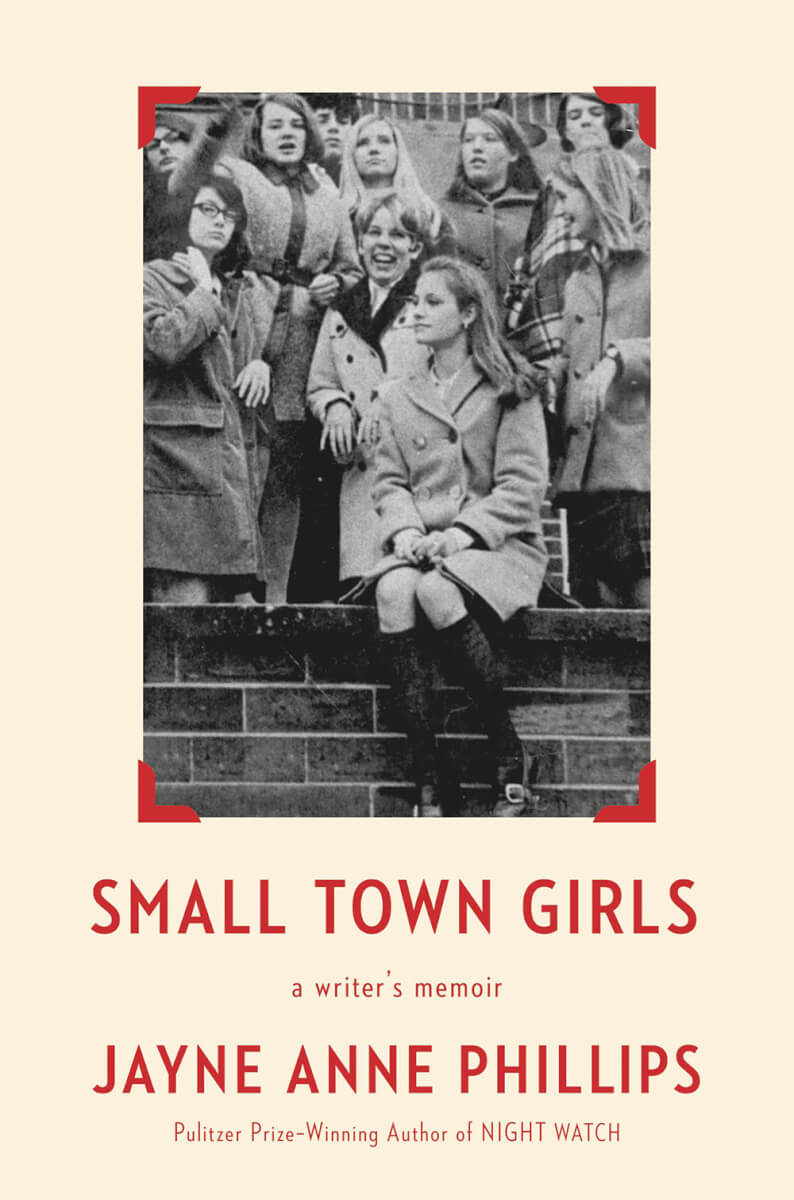
Whether writing fiction or nonfiction, Pulitzer Prize-winner Jayne Anne Phillips (Night Watch) deploys unique depth and eloquence, and in Small Town Girls: A Writer’s Memoir, she distills her goal: “Surely our hope in holding a world still between the covers of a book is to make that world known, to save it from vanishing.”
Small Town Girls offers 22 essays and not a memoir per se, although Phillips certainly shares a cascade of memories, especially about growing up in Buckhannon, West Virginia, in the 1950s and ’60s. Her descriptions of this setting—Friday night football and family-owned businesses that welcomed customers by name—convey small-town pride that will be especially evocative to readers who grew up in similar circumstances. Phillips doesn’t sugarcoat in her reminiscing, however, describing the poverty of families who lived in nearby rural hollows and how her mother, a teacher, often tried to help.
Whatever the subject, Phillips’ observations shine, such as in a memorable essay about the Barbara Stanwyck-starring TV Western, The Big Valley. Elsewhere, she remembers the late West Virginia novelist Breece D’J Pancake and her youthful fixation on English model Jean Shrimpton. She reports on the funeral of three teenage girls killed by a school shooter in Paducah, Kentucky, in 1997. In “Road Trip: The Real Thing,” she writes with pure delight about driving, Thelma and Louise-style, with her best friend in a red Jaguar convertible from Massachusetts to Bar Harbor, Maine. In “On Not Having a Daughter,” the mother of two sons contemplates an abortion. This essay is particularly potent in light of her references to her beloved mother and her death: “I was my mother’s only daughter, the one who would inherit the dishes, the cradles, the woman’s things, and the stories.”
As a person with deep West Virginia roots, I particularly appreciate Phillips’ defense of her home region, calling, for instance, the popularity of the Hatfield-McCoy feud “yet another condescending variation of Appalachia bashing.” She adds, “It’s (thankfully) no longer acceptable to be openly racist or sexist . . . but it’s perfectly OK to bait Appalachia: no understanding of history necessary.”
One can’t help but wonder if Phillips may be too private to write a more traditionally styled memoir. In fact, she admits, “I have patterned my adult life on escape and redemption, escape being flight, movement, self-reliance; redemption being the circling back, the writing, the saving of a version of events that is emotionally real, that can’t ever recede or be lost.” Regardless, Small Town Girls is a powerful example of Phillips’ immense talents.