
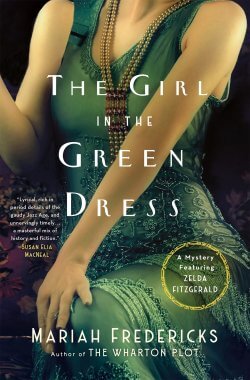
Mariah Fredericks has written five mysteries set in 1910s New York City (including one starring Edith Wharton!), and her next book jumps forward a decade to the Roaring ’20s, where Zelda Fitzgerald and journalist Morris Markey team up to solve a puzzling crime.
What made you choose Morris Markey (a real person, although there isn’t evidence he knew Zelda Fitzgerald) for your narrator instead of creating someone fictional or turning to Zelda herself?
I first had the idea for this novel when I was googling New York + murder—as one does—and found an old Esquire article on the 1920 murder of Joseph Elwell. He was found in his townhouse, shot through the head, all the doors and windows locked. The writing was breezy and colorful, so I looked up the author, Morris Markey. I learned two things about him: He had been a reporter for The New Yorker in the ’20s and ’30s. And the same year he wrote the Elwell piece, he was found in his home, a bullet through the brain. That seemed too good to pass up.
Zelda has a dazzling mind, but it’s not suited to being the point-of-view detective. It just wouldn’t be her primary focus, and who could blame her? But she was always up for adventure and she makes a very good foil for Markey. He and Zelda were both Southerners who shaped New York’s Jazz Age mythology. They were what E.B. White called settlers, people who give the city its passion because they were “born somewhere else and came to New York in quest of something.”
“I first had the idea for this novel when I was googling New York + murder—as one does.”
Joseph Elwell’s case is a true story. Why did you want to explore that cold case?
Certain stories make tabloid headlines for a reason. Then and now, [the Elwell case] had the elements that attract people to a story: wealth, sex, celebrities. The pink kimono alone! It’s a locked-room mystery—S.S. Van Dine based his first Philo Vance novel on the case. While it’s not a front-runner in “crimes that inspired The Great Gatsby” stakes, Fitzgerald would have been aware of it, and there are parallels. Then I discovered that Markey had died in a similar way the same year he wrote about the case and knew I had to do it.
The book opens with Markey’s death in 1950. Do you believe he was murdered or died by suicide?
His wife believed it was suicide. His friend James M. Cain suspected it was murder. (James Thurber, also a friend, thought it was an accident.) The coroner couldn’t render a verdict. There’s evidence to support murder or suicide. After going down one of the deepest research rabbit holes I’ve ever done—I was obsessed, as my poor family will tell you—I feel satisfied I know what happened. Hopefully it’s a satisfying conclusion for the reader as well.
You hint at Zelda’s mental health struggles (her likely bipolar disorder was not diagnosed in her lifetime). How did you approach that aspect of her character, and what research did you do?
There’s a school of thought that Zelda was just a singular, original woman deemed insane by her insecure husband and sexist, incompetent medical practitioners. But her brother suffered from what was called “nervous prostration” and died by suicide, as did her aunt. There’s evidence of illness on both sides of her family. So it’s reasonable to think she was struggling with something organic.
But in 1920, at a time when youth was supposed to be wild and outrageous, it’s easy to interpret her behavior as “high spirits” or attention seeking. There are times when she puts herself at risk, and you wonder if it’s a cry for help, almost “stop the world, I want to get off.” But she wasn’t hitting her low lows yet. People remember her conversation as lively but random, so I tried to capture that. Also a sense that parties, celebrity and infatuation can have a splintering effect on the identity.
Zelda struggles when she’s not the center of attention, and although she’s a huge contributor to her husband’s literary success, her name isn’t on his books. Do you think she had that much influence on him in real life?
Some of Fitzgerald’s most famous lines—beautiful little fool, for example—were said by Zelda. He mined her diaries for feelings and experience, quoting passages almost verbatim. His novels draw on their life together, so much so that when Zelda wanted to write her own novel, he insisted their marriage—and her life—was his creative property. Publicly, she was a sign that he lived the gorgeous, sexy, hedonistic life he wrote about. They were a great team in that respect. But in fairness to Fitzgerald, he did write the novels.
“Parties, celebrity and infatuation can have a splintering effect on the identity.”
If Zelda was born into today’s world, what do you think she would be doing?
Zelda and social media—the mind boggles. Zelda, the Queen of TikTok! The short, hopeful answer is that she would have gotten far better treatment for her mental health issues and had much more scope for her particular genius. But she was lovely, charismatic and a risk-taker. Today’s world has perils for people like that as well.
This is a locked-room mystery. What do you enjoy about that trope, and how did it shape the nature of the investigation?
I first got seriously interested in the locked-room trope with The Lindbergh Nanny. The kidnapping doesn’t adhere strictly to the rules of the puzzle, but it has similar emotional and thematic elements: the danger inside the house; someone seen as safe turns out to be a mortal threat. Elwell was shot in his home, sitting down as he was reading his mail. He didn’t fear the person at all, and that’s why he let them in.
Zelda famously died in a fire at Highland Hospital. She and several other women had been locked in their room and were unable to get out. It was horrific. You can see her marriage and early fame as locked rooms—blissful but also traps. Also her illness. At one point in The Girl in the Green Dress, Markey explains his panic attacks, reacting to things he knows are not real, and she says, “You’re trapped in your mind.” The two never met in real life, but I suspect that’s something they had in common.
Read our review of ‘The Girl in the Green Dress’ by Mariah Fredericks.
There are a lot of parallels between the 1920s—with its conspicuous consumption and government surveillance of “non-patriots”—and today. Was that something you were trying to draw attention to?
Joseph Elwell was a member of the American Protective League, a group of self-appointed, privately funded citizen spies who, with the government’s permission, targeted people seen as having pro-German sympathies. At one point, they had 300,000 members. A stunning number of people were detained based on the APL’s reports, including one of the suspects in the Elwell murder. When I wrote the book, I thought a group of citizen vigilantes attacking “disloyal” Americans and the foreign-born might not resonate. I’m very sorry that it does. One of my elected officials was arrested by men in baseball caps and masks. They were government officials but wore no visible identification. The line between vigilante and state power is dangerously blurred.
One aspect that did resonate while I was writing was the sense of multiple selves. Public personas become so intense during the ’20s as movies really become part of mass culture. Celebrity took on a whole new power as it has today with social media.
Were the Fitzgeralds’ parties really as raucous as the book makes out?
More. In the book, Zelda invites a young man to join her in the bathtub. The tub is dry; she’s still dressed. But in real life, she wasn’t.
The book presents the idea that women were the true drivers of the Jazz Age. Is this something you found in your research?
One of the things that struck me when I read This Side of Paradise is the focus on women. The “shocking secret,” as Fitzgerald biographer Arthur Krystal says, is that “girls just want to have fun.” They are accustomed to being kissed. They dine in “impossible cafes.” When hero Amory Blaine considers the “vast juvenile intrigue” of the era, he’s talking about girls who are now doing things once considered forbidden—and doing them with an air of great casualness and ease. What’s the image of the 1920s? The flapper. Nothing is more iconic than bobbed hair. Fitzgerald paid attention to women, he loved talking to them. I think you feel that in his work and it’s just one of the reasons he’s lasted.
Author photo of Mariah Fredericks by Jonathan Elderfield.